
“It says commercial grade on the box, so that’s the same thing, isn’t it?”
Usually not, and the gap costs money in both directions: businesses over-specify floors for quiet rooms, and under-specify them at the door where every customer walks. Three things separate commercial from residential vinyl plank, and none of them is the word on the box: a wear layer commonly 0.55 mm or more, an EN ISO 10874 class of 33 or higher, and glue-down installation instead of a floating click floor.
The rest of this guide is what each of those means, where the money actually goes (it’s the slab), and why a residential floor, however good, is usually the wrong buy for a workplace.
The Three Numbers on the Spec Sheet
| What to ask for | Entry residential | Commercial (standard) | Commercial (heavy traffic) |
|---|---|---|---|
| Wear layer | 0.3 mm | 0.55 mm | 0.7 mm |
| EN ISO 10874 class | 23 (heavy domestic) | 33 (heavy commercial) | 34 / 42 (very heavy commercial, general industrial) |
| Installation | Floating click | Glue-down | Glue-down |
| Typical total thickness | 5–8 mm rigid core | 2–2.5 mm | 2.5–3 mm |
The classification is the number that actually means something. A typical commercial spec sheet reads like this: 2.5 mm thick, a 0.55 mm wear layer, and class 23, 33, 42, meaning heavy domestic, heavy commercial and general industrial in one product. That is what a commercial LVT looks like on paper.
Notice the thickness column. A commercial vinyl plank is usually thinner than a residential hybrid, because it isn’t holding itself flat: the adhesive and the slab do that. Thickness is a floating-floor problem, not a durability measure.
Wear Layer Isn’t the Whole Answer, and Our Own Range Proves It
Here’s the awkward fact for anyone selling on wear layer alone. Our Aspire hybrid runs a 0.7 mm wear layer and Easi-Plank 0.5 mm, so a residential Aspire plank has a thicker wear layer than the 0.55 mm commercial LVT above. Budget SPC sits at about 0.3 mm. (If hybrid is new to you, our plain-English explainer covers the construction.)
So why is the LVT still the commercial floor? Because durability in a workplace isn’t only about the surface film:
- Class rating. Class 33 and 42 are tested for commercial and light-industrial traffic: residual indentation, castor-chair testing, abrasion. A 0.7 mm wear layer on a domestic-class board doesn’t inherit that.
- How it’s held down. Glue-down planks don’t move. A floating floor moves with temperature, which is fine in a bedroom and a problem in a shopfront with afternoon sun.
- Repairability. Lift one glued plank, scrape, re-glue. On a click floor you either dismantle back to the damaged board or live with it.
- Warranty. Commercial ranges carry a commercial warranty. A residential warranty usually excludes commercial use altogether, so read that clause before you buy a “commercial grade” plank for a shop.
Glue-Down or Click: the Long-Run Problem
This is the part that decides most jobs, and it’s rarely mentioned until the quote is in.
A floating click floor (hybrid, SPC or click LVT) needs an expansion gap around every wall, column and door jamb, and its manufacturer sets a maximum run before an expansion joint has to go in. In a three-bedroom house you rarely meet that limit. In a 300 m² open-plan office or a long retail tenancy you meet it immediately, and the answer is either a trim strip across the middle of the floor or a different product.
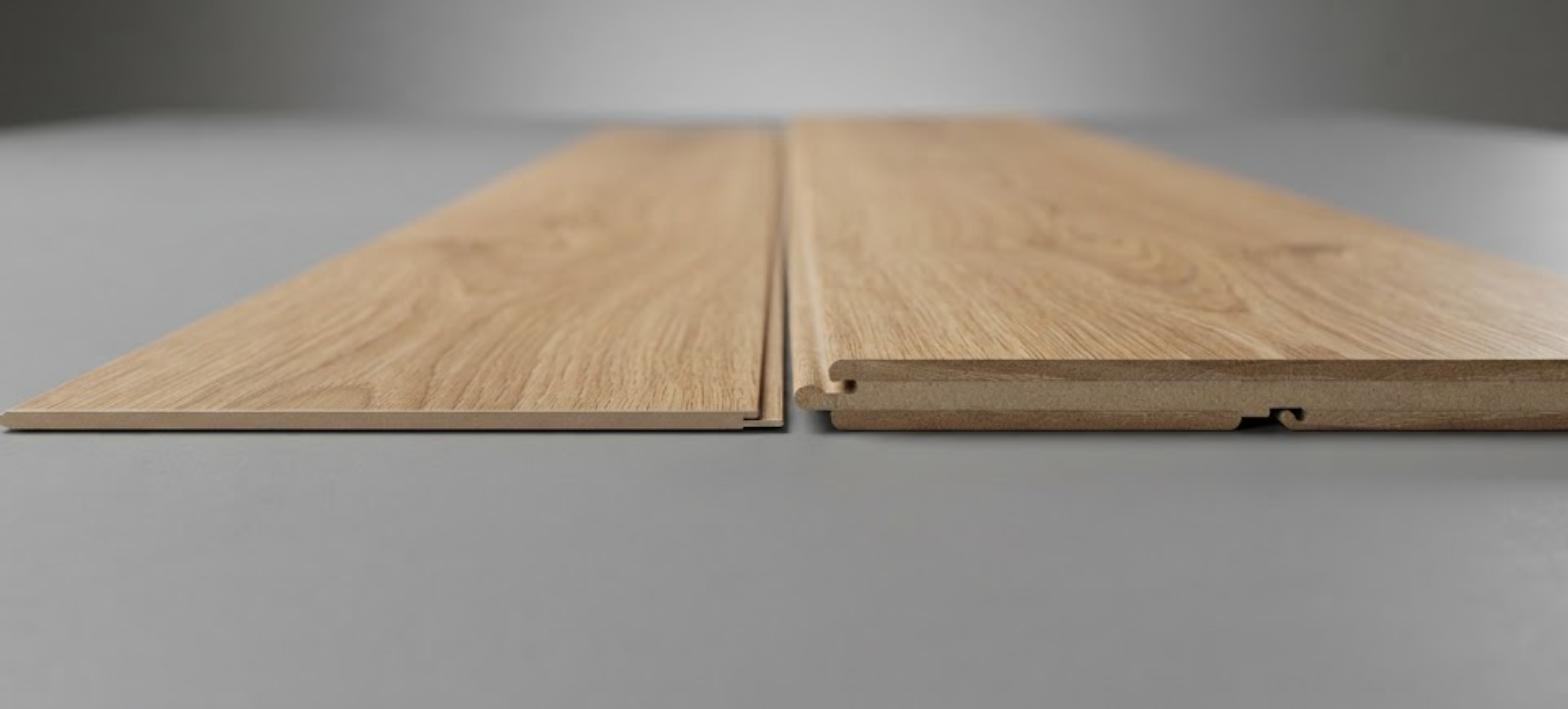
Glue-down has no expansion limit. It also takes trolleys, pallet jacks and office chair castors without the plank skating, and it’s quieter underfoot than a floating floor over a slab, which matters in a fit-out where the ceiling is open and hard surfaces are everywhere.
What glue-down demands in return is a better slab. Which is the next section, and the real budget line.
The Slab Is Where the Money Goes
Australian standard AS 1884:2021 governs resilient floor installation, and two of its requirements decide what your job costs:
- Moisture: the slab has to be under the moisture limit set by the standard or the flooring manufacturer. Since the 2021 revision, the in-situ RH probe test to ASTM F2170 is the only normative method, and the old surface hood test is no longer accepted. Probes sit in drilled holes and need 24 hours before they’re read, so this is a step booked in advance, not done on the morning.
- Flatness: the tolerance for a glued floor is tighter than a floating floor needs, because a glued 2.5 mm plank telegraphs every ridge and hollow underneath it.
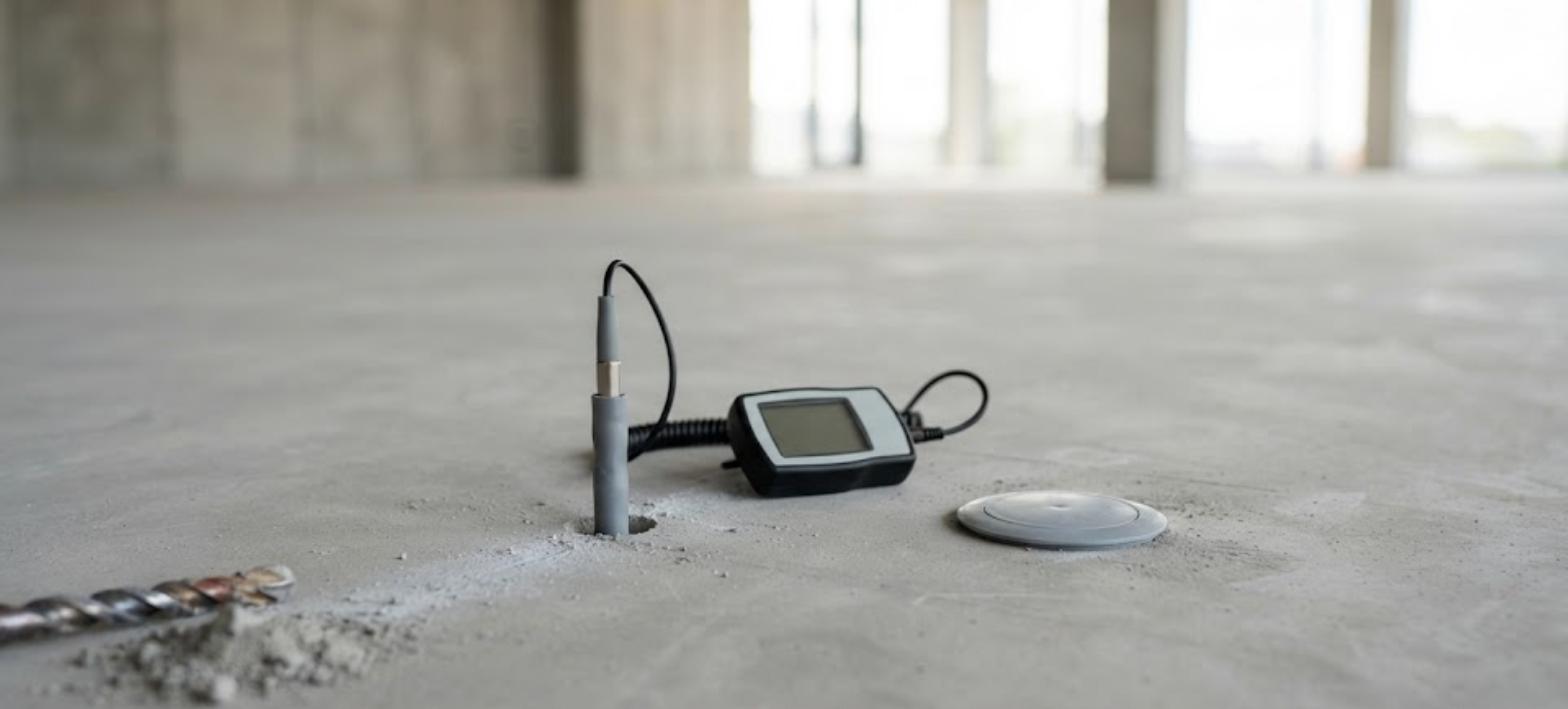
A green slab that fails the RH test is not a reason to change product. It’s a reason to schedule around it or price a moisture barrier. Skipping the test and gluing anyway is how a floor lifts at the joints eight months later, and no warranty covers it.
Budget $25–45/m² for levelling where the slab needs it, and $150–300 for moisture testing: the same lines that appear in our flooring and carpet cost guide.
Slip and Fire: What the Quote Has to Name
Two compliance numbers, and both are commonly quoted from the wrong test.
Slip. Australia specifies to AS 4586, which contains more than one test: the wet pendulum, which produces a P rating (P0–P5), and the oil-wet ramp, which produces an R rating (R9–R13). Commercial kitchens are commonly specified at R12. An R number and a P number are not interchangeable, so the question to ask a supplier is which test produced this rating, and for an entry that gets wet in a Sydney southerly, ask for the pendulum figure.
Fire. Floor coverings are tested to AS ISO 9239.1 and rated by critical radiant flux. For most commercial buildings the NCC sets 2.2 kW/m² without sprinklers and 1.2 kW/m² with them, 2.2 kW/m² in fire-isolated exits, and 4.5 kW/m² in unsprinklered aged-care and patient care areas. Ask for the test report, not the reassurance.
If you’re fitting out an apartment building’s common areas rather than a workplace, the acoustic by-laws matter as much as either of these, and our guide to flooring in Sydney apartments covers how those ratings work.
What Moves the Price
Commercial vinyl plank is priced per site, because the slab, the access and the hours move the number more than the plank does. The fixed lines are the same ones in our flooring and carpet cost guide: moisture testing at $150–300, levelling at $25–45/m² where the slab needs it, $40–80/m² to demolish old tiles or glued vinyl, and a 10–15% premium on jobs booked inside two weeks. After-hours work on an occupied tenancy is a line of its own, and it should be visible on the quote.
One comparison worth making before you price anything: laminate is a poor workplace floor, even at AC5. An HDF core and a daily wet mop are a bad combination, and water at the joins is what ends it. Our hybrid vs laminate comparison explains why the core is the difference.
Where Each One Belongs in a Sydney Fit-Out
The mix that most jobs land on, rather than one floor everywhere:
| Zone | What goes down | Why |
|---|---|---|
| Entry, lift lobby | Glue-down commercial vinyl plank, or tile with entry matting | Every customer, every wet day |
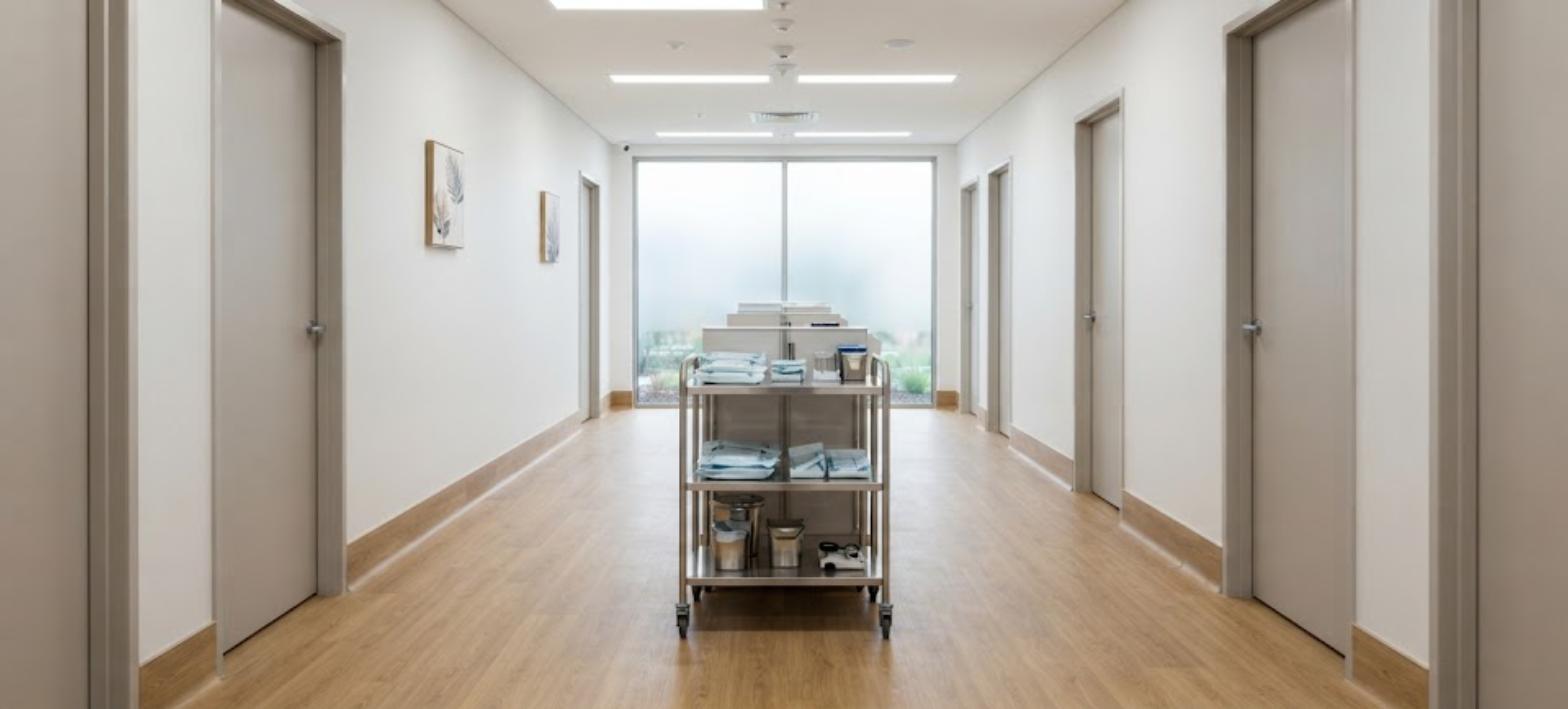
| Café, kitchenette, clinic room | Glue-down commercial vinyl plank | Spills, mops, castors |
| Open-plan workstations | Carpet tiles | Acoustics, and you replace a lane instead of a floor |
| Meeting rooms, private offices | Carpet tiles or broadloom | Quiet, low traffic |
| Boardroom, showroom | Engineered timber | It’s the room people photograph |
Sydney adds its own variables. Ground-floor tenancies in the Hills business parks around Norwest and Castle Hill are usually slab-on-ground, easy access, business-hours work: the cheapest version of this job, and our Castle Hill showroom is ten minutes away. A tenanted floor in a CBD or North Sydney tower is after-hours only with the dock and lift booked, which adds labour time and should be its own line on the quote. And on the Northern Beaches, the medical, childcare and light-industrial tenancies around Frenchs Forest, Brookvale and Warriewood are the classic mixed job: hard floor in the wet zones, carpet everywhere else, and two trades’ worth of transitions to get right. Our Belrose showroom is the place to compare them side by side.
The Part That Costs Us Money
Don’t over-specify. A 30 m² boutique with two staff and a quiet street does not need a class 42 industrial plank with a 0.7 mm wear layer. A standard 0.55 mm, class 33 plank will outlast the lease, and the difference buys the entry matting that actually protects the floor. Grit at the door wears out more flooring in Sydney than traffic ever does.
The reverse is just as true, and it’s the more expensive mistake: a click floor in a café, a busy clinic or a shopfront with western sun is a callback waiting to happen. If the floor is going somewhere with trolleys, mops or sun, glue it down.
Frequently Asked Questions
What wear layer do I need for a shop or office?
0.55 mm is the commercial standard and suits most shops, offices and cafés. Step up to 0.7 mm where traffic is constant or trolleys are involved. Below 0.55 mm you are buying a residential floor, whatever the box says.
What’s the difference between LVT and hybrid flooring?
LVT is a flexible vinyl plank, usually 2–2.5 mm and glued down. Hybrid has a rigid mineral-polymer core, is 5–8 mm thick and floats with a click system. Hybrid is easier and cheaper to install; LVT holds up better under commercial traffic and has no expansion limits.
Can I use hybrid flooring in a café or shop?
Check the warranty first: most residential hybrid warranties exclude commercial use. Beyond that, a floating floor needs an expansion gap, an expansion joint once a run passes the manufacturer’s limit, and it moves with heat. Glue-down is the right answer there.
Is commercial vinyl worth it in a house?
We supply vinyl planks as a commercial product, not for homes. For a house, our hybrid range is the answer: 0.5–0.7 mm wear layers and a waterproof core, subject to product and warranty conditions, and it’s cheaper installed. What “waterproof” does and doesn’t cover is worth reading first.
How long does commercial vinyl plank last?
It depends on the class, the traffic and the cleaning more than the price. Commercial ranges are built and warranted for commercial traffic; residential ones usually aren’t. Entry matting and regular cleaning move the life of the floor more than anything else you can buy.
What decides the price of a commercial vinyl plank floor?
The slab, the access and the hours, more than the plank. It’s priced per site after a measure. The fixed lines: moisture testing $150–300, levelling $25–45/m² where it’s needed, and $40–80/m² to demolish old tiles or glued vinyl.
Get It Specified Properly
A lot of the commercial floor problems we get called to look at are specification problems, not product problems: a domestic-class plank in a doorway, a floating floor in a room that needed glue, a slab nobody tested. Book a free site measure and quote and we’ll test what needs testing and put the class, the wear layer and the adhesive method in writing on the quote.
The full commercial range (carpet tiles, commercial broadloom, Axminster, commercial vinyl planks and engineered timber) is on our commercial flooring page, and if you want to compare samples in person, both showrooms have them: Castle Hill for the Hills (Hills Super Centre, Shop 85B, 16 Victoria Ave South Building, 02 8606 4840), Belrose for the Northern Beaches (Belrose Shopping Centre, Shop 1.10, 02 9486 3502). Our own installers do the work, and every installation carries a one-year warranty. For the zone-by-zone version across offices, retail, hospitality and strata, see our guide to choosing commercial flooring.