
In an apartment the first question is never which floor. It’s will the building let me — and that answer lives in your by-laws, not in a showroom.
For most Sydney schemes the answer is yes, and the compliant specification is a floating hybrid or laminate floor over an acoustic underlay, hitting whatever impact rating your by-law names — most often AAAC 4 Star, which means an L’nT,w of 50 or lower. You need the owners corporation’s written approval before it goes down, and that approval attaches to the complete tested system: plank, underlay and slab together, never the plank on its own.
That’s the answer. The rest of this guide is the part that stops it going wrong.
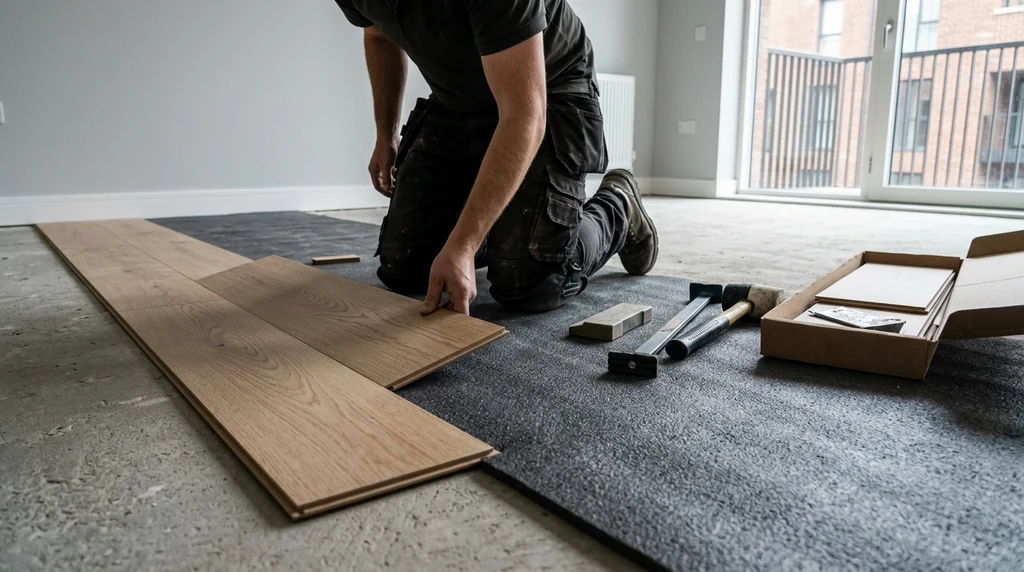
What Gets Approved in a Sydney Apartment
| What you’re laying | Typical strata outcome | The honest read |
|---|---|---|
| Carpet | Almost never needs approval | Still the quietest floor in the building. If the by-law is tight and the budget is tighter, carpet in the bedrooms with a hard floor in the living areas is usually the cheapest compliant answer |
| Hybrid, floating, on its bonded backing | Approved in most schemes | One tested system, one certificate. The simplest paperwork of the three |
| Laminate, floating, over acoustic rubber underlay | Approved in most schemes | Compliant — but only with the right underlay. That underlay is a separate $10–18/m² line, and it’s the line missing from cheap apartment quotes |
| Engineered timber, floating, over acoustic underlay | Usually approved, occasionally not | The same acoustic treatment as laminate at two to three times the board cost, and the hardest of the three to sign off over a timber-framed floor |
| Direct-stick anything | Frequently refused | Gluing a hard floor straight to the slab removes the resilient layer the rating depends on |
Approval requirements vary between schemes. Your by-law is the authority — not this table, and not the salesperson.
There Are Two Rulebooks, and Almost Nobody Separates Them
This is where most apartment flooring conversations go sideways, so it’s worth getting straight before you look at a single sample.
The first rulebook is the National Construction Code, and it governs the builder, not you. Under NCC 2022 Part F7, clause F7D5(1), a floor separating one apartment from another must achieve an airborne rating of Rw + Ctr of at least 50 and an impact rating of Ln,w no more than 62. That was satisfied when the building was certified. It says nothing about what you’re allowed to lay on top a decade later.
The second rulebook is your by-law, and that one governs you. In NSW, hard flooring in a strata scheme needs the owners corporation’s authorisation. The standard model by-law on floor coverings requires that floors be treated sufficiently to prevent noise transmission that would affect other residents’ peaceful enjoyment of their lots — deliberately broad wording, which is why most schemes have since adopted a specific numeric standard instead.
The two rulebooks are not the same standard, and the gap between them is bigger than people expect.
The Number Your By-Law Will Actually Ask For
Most Sydney schemes now reference the star rating system published by the Association of Australasian Acoustical Consultants. It runs from 2 to 6 stars, and the impact column is the one that matters for flooring — lower is quieter.
| AAAC rating | Impact between units (L’nT,w) | Airborne (DnT,w + Ctr) |
|---|---|---|
| 2 Star | 65 | 35 |
| 3 Star | 55 | 40 |
| 4 Star — the usual by-law threshold | 50 | 45 |
| 5 Star | 45 | 50 |
| 6 Star | 40 | 55 |
Here’s the part that explains everything else. For floor impact noise, the Construction Code minimum sits at roughly the AAAC 2 Star level. So a by-law asking for 4 Star is not asking you to meet code — it’s asking you to beat code by a wide margin, on your own money, in a building that was only ever built to the lower number.
That’s not unreasonable. Impact noise — footsteps, dropped keys, chair legs — is what strata noise complaints are usually about. But it explains why the underlay isn’t a detail: in an apartment, the underlay is doing most of the work.
The Rating Belongs to the System, Not the Plank
A plank does not have an acoustic rating. A tested assembly does — a specific plank, on a specific underlay, over a specific slab, measured in a laboratory. Change any one of the three and the number changes.
Practical consequences, in the order they bite:
- Ask for the test report, not the brochure. A compliant product comes with a laboratory impact test result for a named build-up. “Acoustic underlay included” on a spec sheet is not a test result, and a strata committee that has been through this before will know the difference.
- Check what slab it was tested on. Reports are almost always measured over concrete. If you’re in a 1960s or 1970s walk-up with a timber-framed floor rather than a slab, your real-world result will be worse than the certificate — sometimes much worse. That is most of the older red-brick blocks around Dee Why, Narrabeen and Manly; the newer towers along the metro corridor at Castle Hill, Norwest and Kellyville sit on concrete and behave the way the report says they will. We’d rather say that before you order than after your downstairs neighbour complains — and in that building we’ll usually steer you back to carpet in the bedrooms.
- Don’t substitute the underlay to save money. Swapping the tested underlay for a cheaper foam voids the result the approval was granted on, and nothing about the floor will look different until someone measures it.
Hybrid vs Laminate in an Apartment
Both comply. They get there differently, and that difference is worth about $10–18 per square metre.
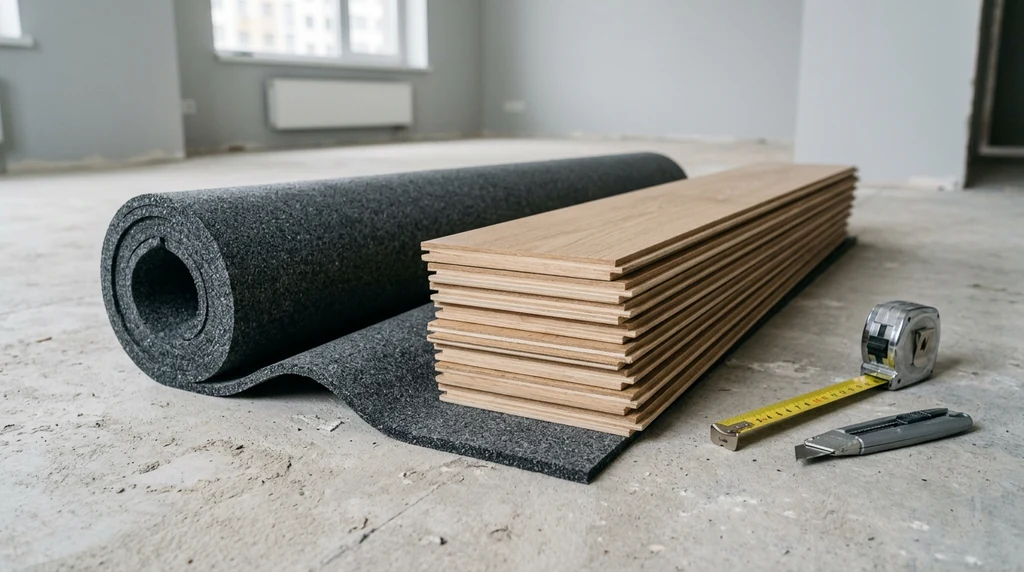
Hybrid planks carry their acoustic backing bonded to the board, so the tested system is the product — one line on the quote, one certificate for the committee. Our guide to what hybrid flooring is covers the construction layer by layer. Hybrid also brings a waterproof core — subject to product and warranty conditions — which matters more in an apartment than in a house, because your spill is someone else’s ceiling.
Laminate never comes with underlay attached. In an apartment it needs acoustic rubber underlay at $10–18/m², not the $6–10/m² foam-and-moisture-barrier that goes under laminate in a house. That is the single most common omission we find when a customer brings in a competing apartment quote: the board is cheap, the labour is fair, and the underlay line is either the wrong product or not there at all. A quote without it isn’t cheaper, it’s just incomplete — and in strata, incomplete means unapproved.
Outside the strata context, our hybrid versus laminate guide sets the two side by side on wear, subfloor tolerance and price.
What It Costs in a Sydney Apartment
Supplied and installed, Sydney 2026, including standard underlay and trims:
| Apartment | Laminate @ $60–80/m² | Hybrid @ $65–85/m² |
|---|---|---|
| One-bedroom, living areas only (~35 m²) | $2,100–2,800 | $2,275–2,975 |
| Two-bedroom, whole floor (~70 m²) | $4,200–5,600 | $4,550–5,950 |
| Three-bedroom, whole floor (~100 m²) | $6,000–8,000 | $6,500–8,500 |
Straight multiplication at the mid-tier rate each product usually lands at. Subfloor preparation and removal of the existing floor are extra.
Across the mid tier hybrid runs about $5/m² above laminate, and $5–10/m² across the full ranges. On a 70 m² apartment that is roughly $350 — less than most people assume, and usually less than the cost of getting the laminate underlay specification wrong once. The complete flooring and carpet cost guide has the full breakdown including the hidden lines.
Two costs that don’t appear in a house quote:
- Access. A fourth-floor walk-up, a booked service lift, restricted delivery hours and paid parking all cost labour time. Real money, and it should be itemised rather than discovered.
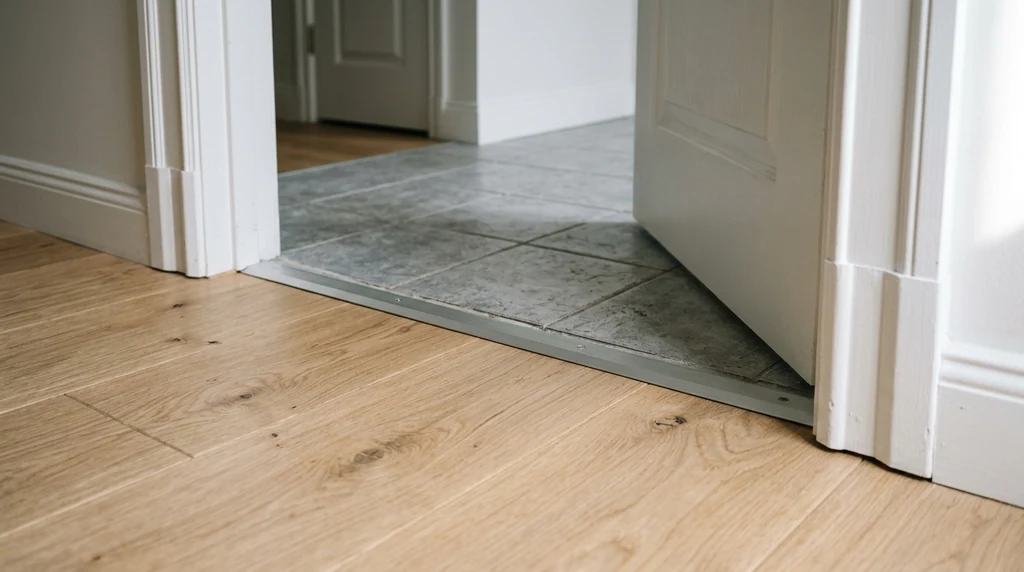
- Existing tiles. Plenty of Sydney apartments have tiled living areas. A floating floor can often go straight over sound, level tiles, which removes demolition — worth $40–80/m² — and keeps skip bins and noisy demo days out of the building entirely. Your strata will prefer it too.
Do This in the Right Order
Ignoring the by-laws until after ordering is one of the most expensive mistakes we see, and it’s entirely avoidable:
- Get your by-laws from the strata manager. Ask specifically whether the scheme names an acoustic standard and what it is.
- Book the measure and choose the system — plank plus underlay — with that number in hand.
- Submit the test report with your approval request. Most committees approve on the paperwork; some ask for a field test after installation.
- Get the approval in writing before the order goes in. Products can be swapped before they’re ordered, not after they’re cut.
Approval timelines vary from a week to a full committee cycle, so start this before you’re emotionally attached to a colour.
Frequently Asked Questions
What flooring is allowed in a strata apartment?
Carpet is allowed almost everywhere without approval. Hard floors — hybrid, laminate, engineered timber — are generally allowed with the owners corporation’s written approval and an acoustic underlay meeting whatever rating the by-law specifies, most often AAAC 4 Star (L’nT,w of 50 or lower). Direct-stick installations are refused more often than floating ones.
Do I need acoustic underlay in an apartment?
If you’re laying a hard floor over a floor that has an apartment beneath it, effectively yes. Laminate needs acoustic rubber underlay as a separate layer at $10–18/m². Hybrid usually carries its acoustic backing bonded to the plank. Either way, what gets approved is the tested combination, not the underlay in isolation.
Do I need owners corporation approval, or just to notify them?
In NSW, installing hard flooring in a strata lot requires authorisation from the owners corporation — notifying them afterwards is not the same thing. Ask your strata manager what the scheme requires and get the answer in writing. It’s free, and it’s the only version that protects you later.
Can I lay a new floor over the existing tiles?
Often, yes. If the tiles are sound, well bonded and level, a floating floor can go straight over them — which removes $40–80/m² of demolition and spares the building a week of noise. Whether yours qualify comes down to condition and floor heights at doorways, which is exactly what gets checked at the measure.
What happens if a neighbour complains after it’s installed?
If you hold written approval and installed the system it was granted on, you’re in a strong position, and the usual next step is a field acoustic test. Without approval, the owners corporation can issue a notice to comply and the matter can end up at NCAT — where one outcome is removing the floor. The paperwork is the cheap part.
Can I put hybrid in an apartment bathroom or laundry?
Sometimes, and it’s product-by-product. Waterproofing in a wet area is governed by AS 3740 and lives in the substrate, not in the floor covering — so the question is what the product’s warranty allows and how it’s installed. Our guide to whether hybrid flooring is waterproof works through where the line actually sits.
Is carpet still worth considering?
In an apartment, genuinely yes. It needs no approval, it outperforms any hard floor on impact noise by a wide margin, and it costs less to put into bedrooms than a compliant hard-floor system does. Plenty of the best apartment jobs we do are hard floors in the living areas and wool or synthetic carpet in the bedrooms, for exactly that reason.
Get It Priced Properly
Apartment flooring is a paperwork job as much as a flooring job, and the quote should reflect that. Book a free measure and quote and we’ll check your floor heights and subfloor, specify a system that meets your scheme’s rating, and give you the test documentation to put in front of the committee — with our own installers, not subcontractors, and a 1-year installation warranty on every job.
Bring your by-laws into the showroom if you have them: our Belrose showroom on the Northern Beaches, at the Belrose Super Centre, Shop 1.10 (02 9486 3502), or our Castle Hill showroom in the Hills, at the Hills Super Centre, Shop 85B, 16 Victoria Ave (02 8606 4840).
For the wider product comparison before strata narrows it down, start with our complete guide to choosing flooring for Sydney homes.