
Here’s the quick answer, since you probably came here for one: choose hybrid if water, pets or coastal humidity are part of your life; choose laminate if you want the most realistic timber look your budget can buy for bedrooms, living areas and rentals. Now the honest part — the ten-second answer misses the details that actually decide it, and a few of those details (one of them hiding under your floor) can flip the maths entirely.
These are the two floors Sydney homeowners shortlist more than any other pair. In photos they can look identical. On a spec sheet they read like cousins — both click-lock, both timber-look, both “durable.” So why does one cost more, and when is it worth it? That’s exactly what this guide settles. (If you’re still weighing up all your options, start with our complete guide to choosing flooring for your Sydney home and come back.)
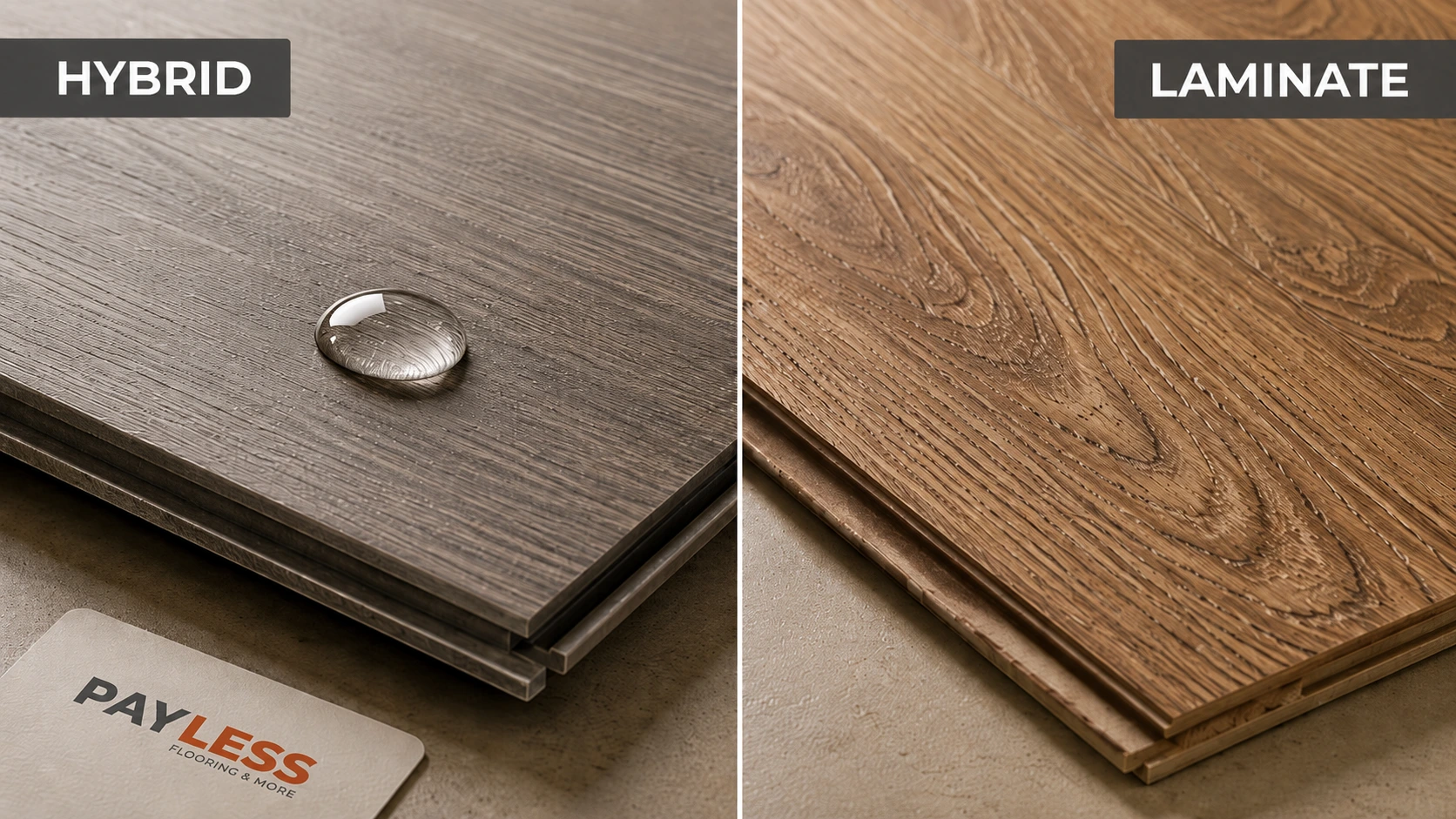
Hybrid vs Laminate Flooring: The 30-Second Verdict
| Hybrid | Laminate | |
| Water | Waterproof core — kitchens, laundries, entries | Water-resistant (48–72 hr rated cores) — not for wet zones |
| Price | Mid-range | Lowest cost per m² of any timber look |
| Feel & sound | Denser, quieter, often has attached acoustic underlay | Slightly harder, more “clicky” without good underlay |
| Scratch resistance | Excellent wear layer — pets & chairs | Very good (AC4/AC5) — still strong for busy homes |
| Best rooms | Whole home incl. kitchen & laundry | Bedrooms, living, home office, rentals |
| Can’t do | Be sanded back — damaged boards get replaced | Handle standing water or genuinely wet areas |
What’s Actually Different Under the Surface
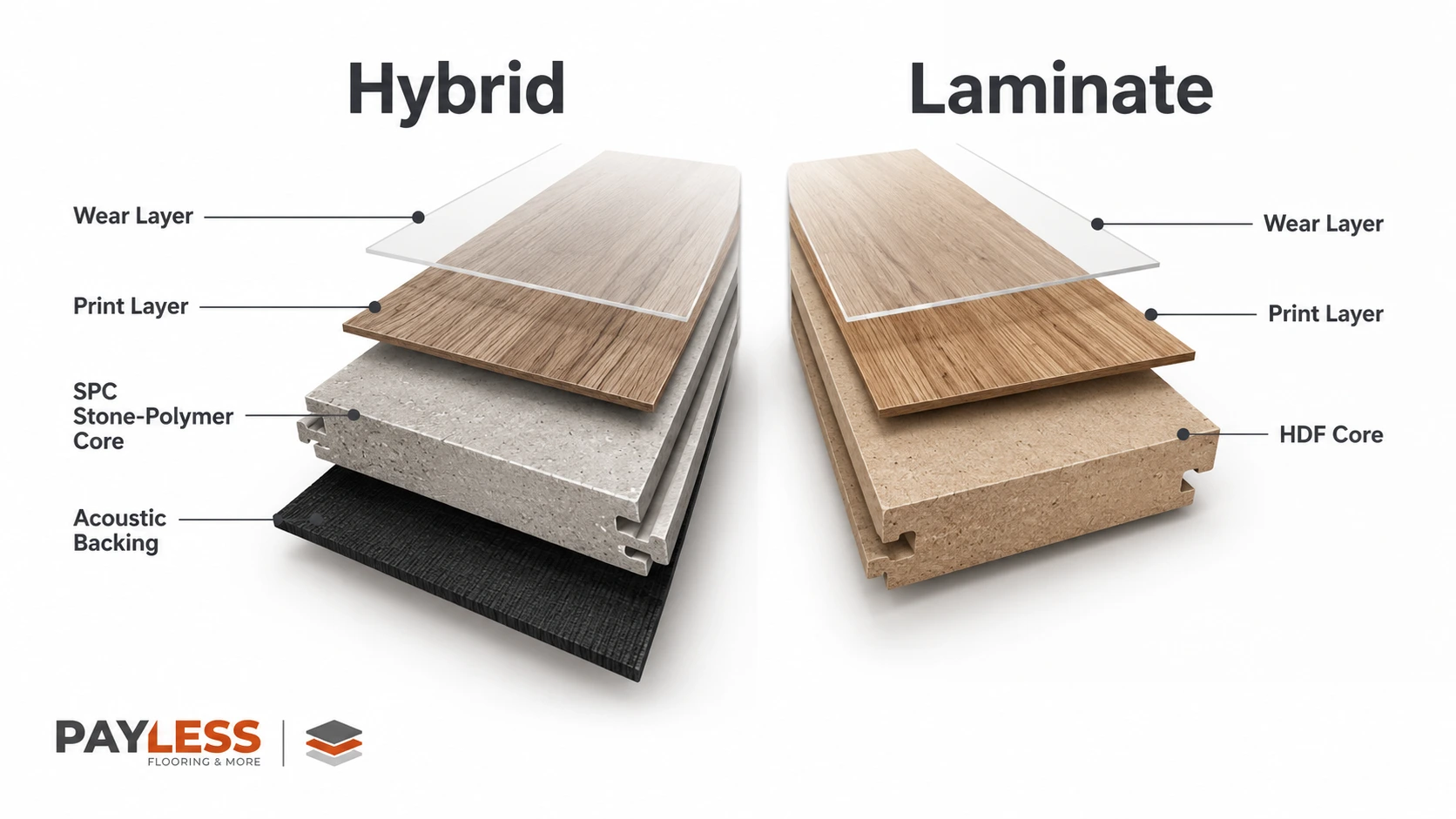
Flip both planks over and the difference stops being subtle. Laminate is built on an HDF core — high-density fibreboard, which is engineered wood fibre. It’s strong and stable, but it’s still a wood product: leave water sitting on an unsealed join long enough and it will eventually swell.
A hybrid plank swaps that core for a rigid mineral-polymer one — SPC (stone polymer composite) or WPC (wood polymer composite). Stone and polymer don’t absorb water. That single change is where almost every practical difference between these floors comes from: the waterproofing, the dimensional stability through Sydney’s humidity swings, and the denser feel underfoot.
The printed decorative layer and protective wear coating on top work the same way on both — which is why they can look identical in a photo while behaving completely differently in a laundry.
Waterproof vs Water-Resistant: The Difference That Decides Kitchens
This is the deciding factor for most Sydney households, so let’s be precise. Hybrid’s core is waterproof — a spilled bottle, a dripping dog bowl or a wet-shoe entryway won’t hurt it. Modern laminate has improved enormously: ranges like the ones we stock carry 48–72-hour water-resistance ratings, which comfortably covers a spill you find and wipe up. What laminate can’t do is live where water is a daily event.
Rule of thumb we give in the showroom: if the room has a tap, a drain or a washing machine in it, go hybrid. Everywhere else, both are on the table. There’s more nuance to what “waterproof” does and doesn’t cover — we’ve unpacked it properly in is hybrid flooring really waterproof?
Scratches, Dents and Daily Life
Both floors are genuinely tough — this is where laminate deserves more credit than it gets. A quality AC4 or AC5 laminate shrugs off foot traffic, kids’ toys and most furniture movement. Hybrid’s wear layer goes a step further on two specific threats: pet claws and dragged dining chairs, where its denser core resists denting better.
If you’ve got a large dog or a dining table that migrates daily, hybrid earns its price difference here. A quieter household with felt pads under the furniture will honestly never find laminate’s limit.
Underfoot: Feel, Sound and the Strata Question
Walk on both in a showroom and you’ll notice hybrid feels denser and sounds more muted — many hybrid planks come with an acoustic foam layer already attached. Laminate on a basic underlay can sound “clickier,” though a good acoustic underlay largely closes that gap.
For apartments this stops being a comfort question and becomes a compliance one: most Sydney strata schemes set acoustic requirements for hard flooring. Both floors can comply, but hybrid’s integrated underlay often makes the paperwork simpler. Always confirm your building’s by-laws before ordering — not after.
The Subfloor Detail Nobody Mentions
Here’s the part most comparison articles skip, and it’s sometimes worth more than the price difference between the two products: what’s under the floor decides part of your quote. Both hybrid and laminate are floating floors, and both need a reasonably flat subfloor to click together and stay quiet. Much of Sydney — especially the Hills District and newer builds — sits on concrete slabs, and slabs are rarely as flat as they look.
Rigid SPC hybrid is a little more forgiving over minor imperfections; laminate telegraphs an uneven slab as movement and noise sooner. Either way, if your slab needs levelling, that’s a real line item — and it’s the reason two neighbours can buy the same floor and get different quotes. It’s also why we measure before we quote: guessing subfloor condition from a phone call helps nobody.
Cost in Sydney: What You’ll Actually Pay
As a working range for Sydney in 2026: laminate typically lands around $50–100 per m² supplied and installed, hybrid around $55–110 per m² — with product choice, plank thickness, room shape and (as above) subfloor prep moving the number inside those ranges. We break down every cost driver in our complete flooring cost guide.
The honest way to read those numbers: over a 15–25-year floor life, the gap between the two often works out to less than the cost of one water-damage repair laminate might need in the wrong room. Get the room choice right and either floor is good value. The fastest way to a real number for your home is a free measure and quote — no obligation attached. For the product-specific detail, see our laminate flooring cost guide and hybrid flooring cost guide.
So Which Should You Choose?
- Choose hybrid if: kitchens/laundries are in scope · you have pets or young kids · you’re near the coast (Belrose, Northern Beaches) · you want one floor to run through the whole home · your strata paperwork is easier with integrated acoustic underlay.
- Choose laminate if: you’re flooring bedrooms, living areas or a home office · it’s a rental or investment property · you’re doing several rooms and cost per m² adds up · you want maximum timber-look realism per dollar.
- Mix them: plenty of our customers run hybrid through the kitchen, laundry and entry, and laminate through the bedrooms — same colour family, two budgets, zero compromise.
You can browse the current hybrid flooring range and laminate flooring range online — or see both side by side in person, which we’d honestly recommend.
FAQs
Is hybrid flooring better than laminate?
Neither is “better” — they’re tuned for different jobs. Hybrid is better wherever water or heavy wear is involved; laminate is better value for dry rooms where budget and timber-look realism matter most.
Is hybrid worth the extra cost over laminate?
If the floor will meet water, pets or coastal humidity — yes, usually within the first accident it prevents. For a quiet bedroom, laminate’s savings are the smarter spend.
What about vinyl — isn’t hybrid just vinyl?
They’re related but not the same: hybrid’s rigid stone-polymer core is an evolution of flexible vinyl plank, built to be more stable and more forgiving over subfloors. We supply traditional vinyl planks for commercial projects — see our commercial flooring page if that’s your use case.
Can both go over my existing tiles?
Usually, yes — both are floating floors and can often be laid straight over sound, level tiles, which saves demolition cost and mess. Condition and levels decide it, which is exactly what we check at the free measure.
Which lasts longer?
With sensible care both run 15–25 years. Hybrid tends to age better in hard-working rooms; laminate ages just as well in dry ones. Room placement, more than product, decides lifespan.
See Them Side by Side
Specs get you 80% of the way; the last 20% is standing on the floor. Visit our Belrose or Castle Hill showroom to compare both ranges in person — or book a free measure and quote and we’ll bring the right samples to the measure.