
Looking for the best flooring for Sydney homes? This guide compares hybrid, laminate and engineered timber for Belrose, Sydney CBD, Northern Beaches and Hills District homes.
Somewhere in the last week, you’ve probably stood in a room, looked down at a floor you’re tired of, and thought: “How hard can this be?”
Then you searched it. And now you have eleven browser tabs open — one comparing hybrid to laminate, one telling you engineered timber is “the only option that adds real value,” one warning you that vinyl scratches if you look at it wrong, and one full of Reddit comments arguing about acoustic underlay. None of them agree. None of them know that your lounge room gets afternoon sun off the harbour, or that your building’s strata by-laws have opinions about noise, or that you’ve got a kelpie who treats hallways like a running track.
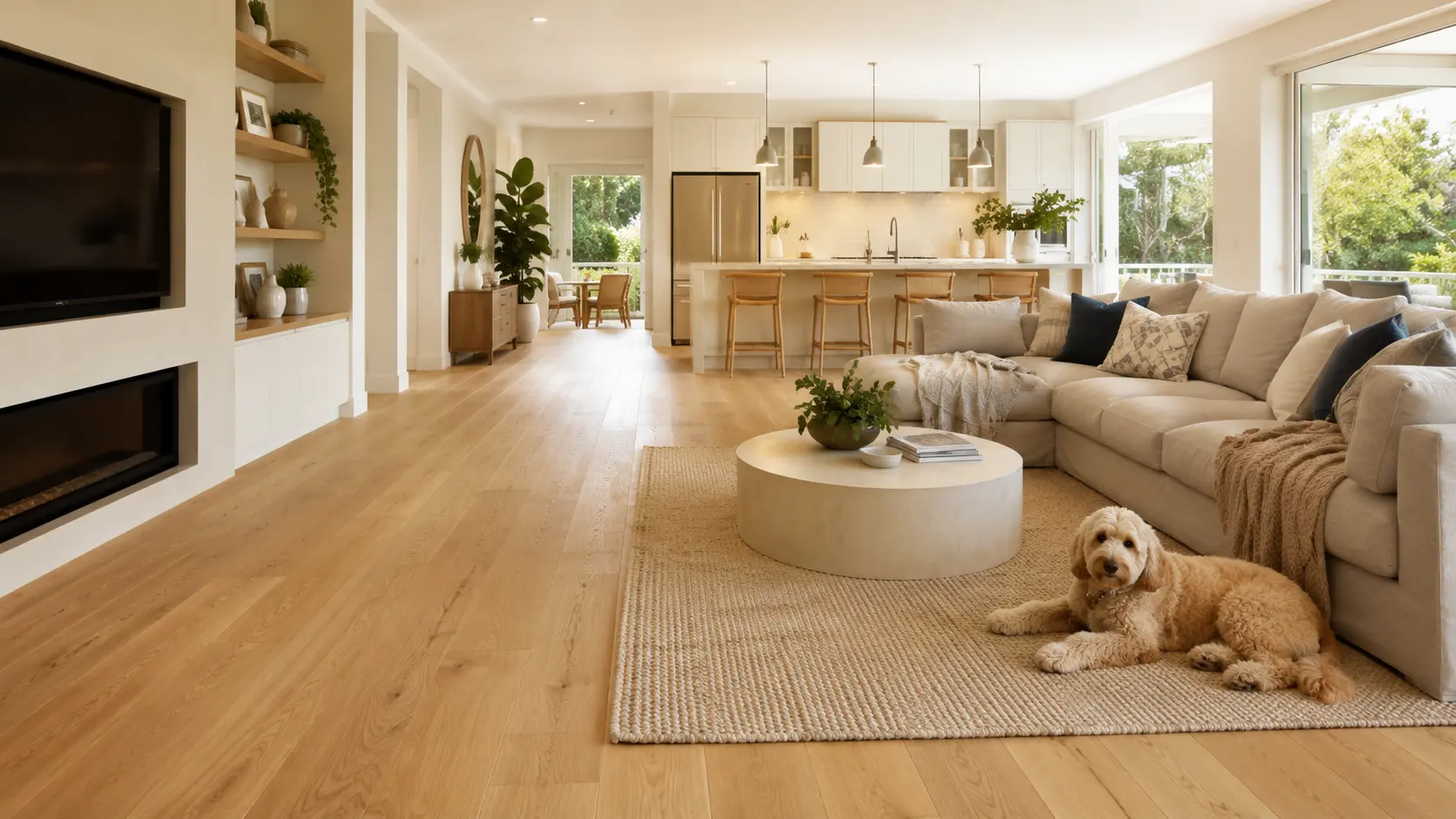
That’s what this guide is for. Not another generic “top 5 flooring trends” list — a straight answer, built around how Sydney homes actually work: the coastal humidity out at Belrose and the Northern Beaches, the concrete slabs across the Hills District, the strata rules in North Shore and inner-city apartments, and the simple reality that most of us are choosing a floor we’ll live with for the next 10–20 years, not the next 10–20 minutes of scrolling.
We’ll walk through the three flooring types we install most across Sydney — hybrid, laminate, and engineered timber — what actually separates them, and which one fits your home, your budget, and your life. If you’re set on carpet or rugs instead, we’ve got dedicated guides for those too.
Why Flooring Is Harder to Choose in Sydney Than Anywhere Else
Every flooring guide on the internet is written for a generic house in a generic climate. Sydney isn’t generic. Three local realities decide more about your flooring choice than any style trend does:
Coastal humidity. If you’re anywhere near Belrose, the Northern Beaches, or the harbour, your home experiences bigger swings in moisture than an inland suburb does. Timber-based products need to handle that movement without cupping or gapping.
Slab-on-ground construction. Much of the Hills District and Sydney’s newer suburbs are built directly on concrete slabs. That affects moisture barriers, subfloor prep, and which products can go down without extra cost.
Apartments and strata rules. Sydney CBD, Inner Sydney and the North Shore have some of the highest apartment densities in the country, and most strata schemes have acoustic requirements for hard flooring — meaning the underlay under your floor matters just as much as the floor itself.
None of this means you need to overthink your decision. It just means the “best” flooring isn’t a universal answer — it’s the one that’s best for your address.
The Quick Answer: Which Flooring Suits You?
If you only read one section, read this one.
| Your situation | Best fit | Why |
|---|---|---|
| Family with kids and/or pets | Hybrid | Fully waterproof core, scratch-resistant wear layer, handles spills and claws without drama. |
| Investment or rental property | Hybrid or Laminate | Durable, low-maintenance, competitively priced, easy for tenants to live with. |
| Apartment or strata property | Hybrid or Laminate with acoustic underlay | Floating floors with integrated acoustic layers help meet body corporate noise requirements. |
| Coastal home in Belrose or the Northern Beaches | Hybrid | Fully waterproof, dimensionally stable through humidity swings. |
| Renovating for resale or long-term value | Engineered Timber | Genuine timber surface, the strongest perceived value to buyers. |
| Tight budget, still want a timber look | Laminate | The most affordable way into a realistic timber-look floor. |
If your situation doesn’t fit neatly into one row — most don’t — keep reading. We’ll go deeper on each option below.
Hybrid Flooring: The All-Rounder
Hybrid is the flooring type we install the most across Sydney right now, and for good reason: it’s built to solve the exact problems homeowners complain about with older flooring types.
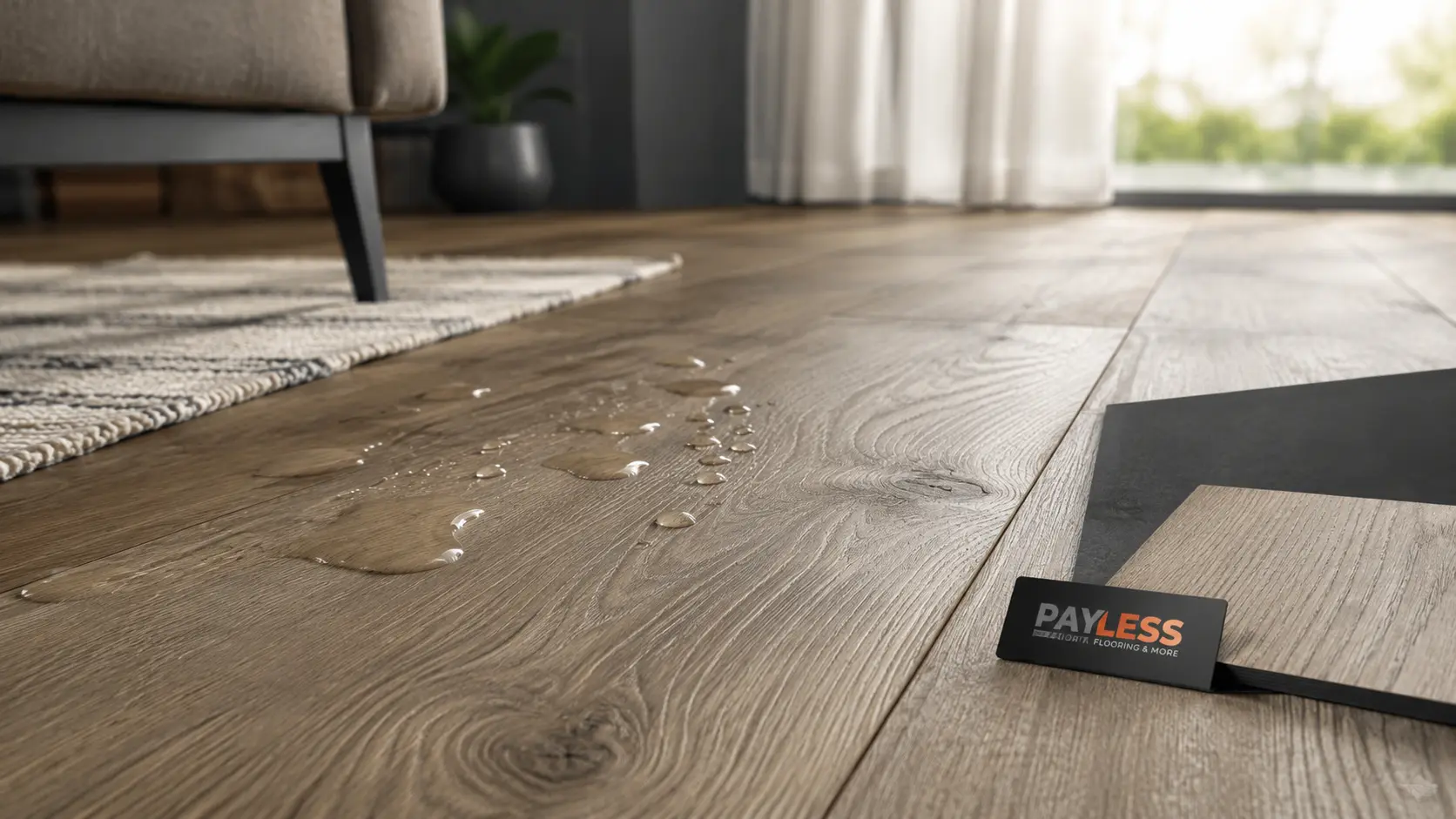
At its core, hybrid flooring uses a rigid base — either SPC, stone polymer composite, or WPC, wood polymer composite — topped with a printed decorative layer and a protective wear coating. That rigid core is what separates it from old-style vinyl, and it’s why hybrid handles Sydney conditions so well:
- Waterproof core — great for kitchens, laundries, entries and high-spill areas, subject to product and warranty conditions.
- Dimensionally stable — SPC in particular barely moves with temperature or humidity changes, which matters near the coast
- Scratch and dent resistant — a real consideration if you’ve got dogs, kids, or a habit of dragging dining chairs
- Click-lock installation — floats over most existing subfloors, including tiles, with minimal disruption
- Built-in acoustic underlay — many hybrid planks come with an attached foam layer that reduces impact noise, which is exactly what apartment buildings look for
The trade-off: hybrid can’t be sanded back or refinished the way solid or engineered timber can. If a board is badly damaged, you replace that board — you don’t restore it. For most households, that’s a fair exchange for never worrying about a spilled glass of wine again. Still weighing it against laminate? Our full hybrid vs laminate flooring comparison settles it room by room.
We range hybrid in both SPC, which is denser and ideal for busy households and temperature swings, and WPC, which is a little softer and quieter underfoot. You can browse the full hybrid flooring range to see current colours and finishes, from warm mid-tone oaks to contemporary greys.
Laminate Flooring: The Smart Budget Choice
Laminate gets an unfair reputation from products people saw fifteen years ago. Modern laminate — the kind we range today — is a different product entirely.
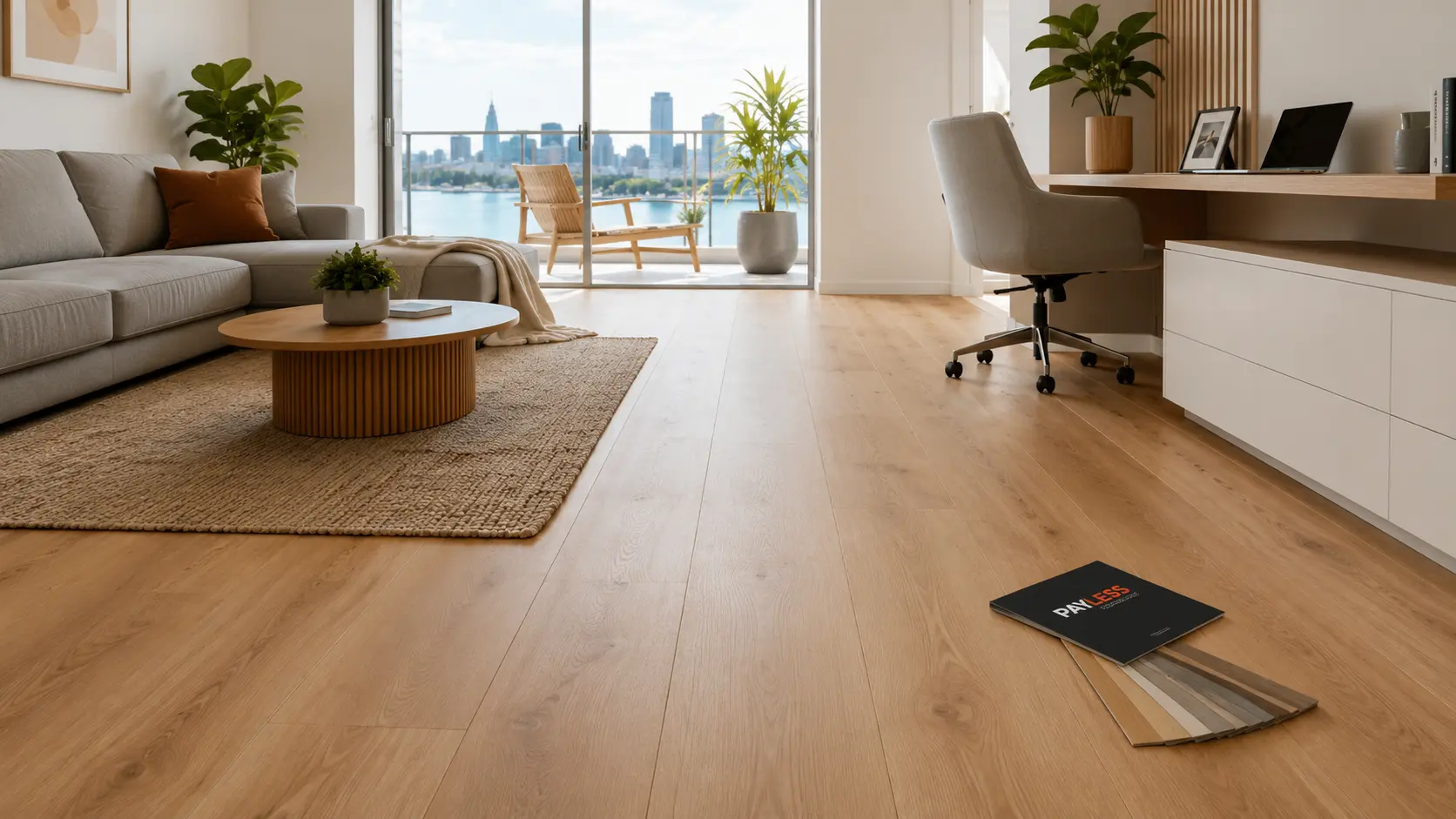
Laminate is built around a high-density fibreboard, or HDF, core, with a high-definition printed layer on top that replicates timber grain with a level of realism that genuinely surprises people, finished with a protective wear layer. Newer ranges also include water-resistant cores rated to withstand spills for 48–72 hours before any damage occurs — a meaningful upgrade from older laminate that swelled the moment it got wet.
Why homeowners choose it:
- The lowest cost per square metre of any timber-look flooring option
- AC-rated durability — AC4 and AC5 ratings indicate how well a product handles foot traffic and impact; the higher the number, the tougher the floor
- Fast, simple click-lock installation
- A huge range of finishes — from washed European Oak tones to darker, high-contrast looks
Laminate is an easy recommendation for rental properties, home offices, bedrooms, and any renovation where budget matters as much as the finished look. It’s less suited to genuinely wet areas than hybrid — check the specific water-resistance rating of the range you’re considering if that’s a priority.
Our current ranges include the Oakleaf and Oakleaf HD Plus collections, with European Oak and Australian timber visuals, AC4-rated surfaces and a 48-hour water-resistant core, plus Aquastop, engineered by the Swiss Krono Group with up to 72-hour moisture protection depending on thickness. You can browse the full laminate flooring range to compare finishes and specs.
Engineered Timber: The Natural Investment
If hybrid and laminate are about performance, engineered timber is about authenticity — it’s real timber, engineered to behave better than solid timber does.
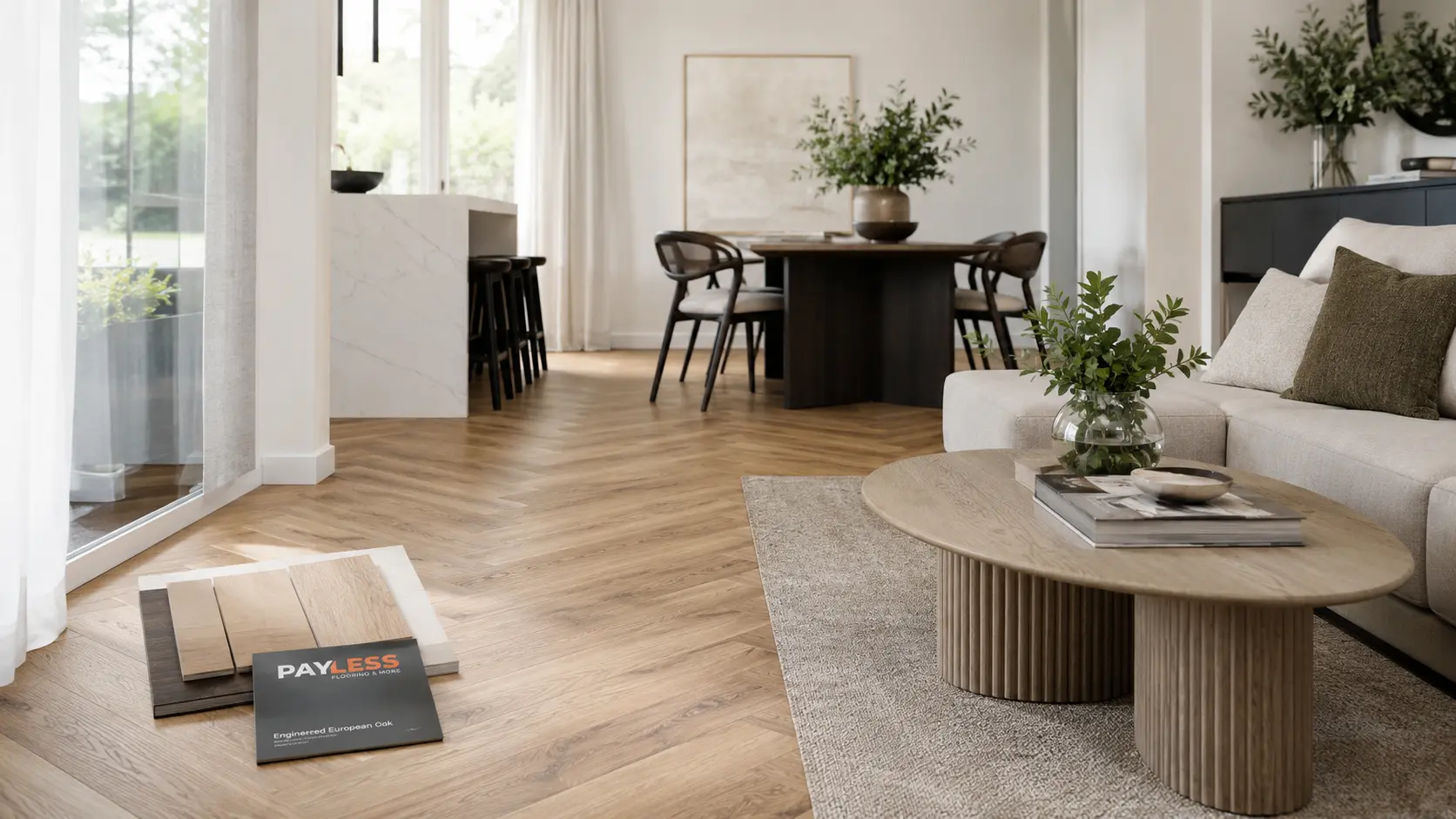
Engineered timber is built in layers: a genuine hardwood veneer on top, usually European Oak, Tasmanian Oak, Spotted Gum, or Blackbutt, bonded to a cross-laminated plywood or HDF core. That layered, cross-grain construction is the whole point — it lets the floor handle Sydney’s humidity swings far better than a single solid plank of timber ever could, while still giving you a surface you can walk on, sand, and refinish, typically once to three times depending on the thickness of the wear layer.
Why homeowners choose it:
- Genuine timber surface — real grain, real character, ages the way natural materials do
- Strongest resale appeal — buyers and valuers consistently rate it above laminate or hybrid
- More stable than solid timber in slab-on-ground homes and humid conditions
- Refinishable — a scratched or dated floor can be sanded back rather than replaced
- Available in classic plank, wide plank, herringbone, and chevron layouts for a genuinely premium finish
The honest trade-off: engineered timber is not waterproof, and it’s a bigger investment than hybrid or laminate. It performs best in living areas, bedrooms, and hallways rather than bathrooms or laundries, and it benefits from a slightly higher level of care.
Our engineered ranges include Artisan Oak, with European Oak, Valinge 5G click profile and pre-finished boards, and Pronto, with a 3mm solid Oak wear layer over an 11mm plywood substrate, along with herringbone, chevron, and wide-plank layouts. Explore the full engineered timber flooring range to see current species and finishes.
Choosing By Your Actual Situation
Specs are useful, but most people decide based on how they actually live. Here’s how that plays out in practice.
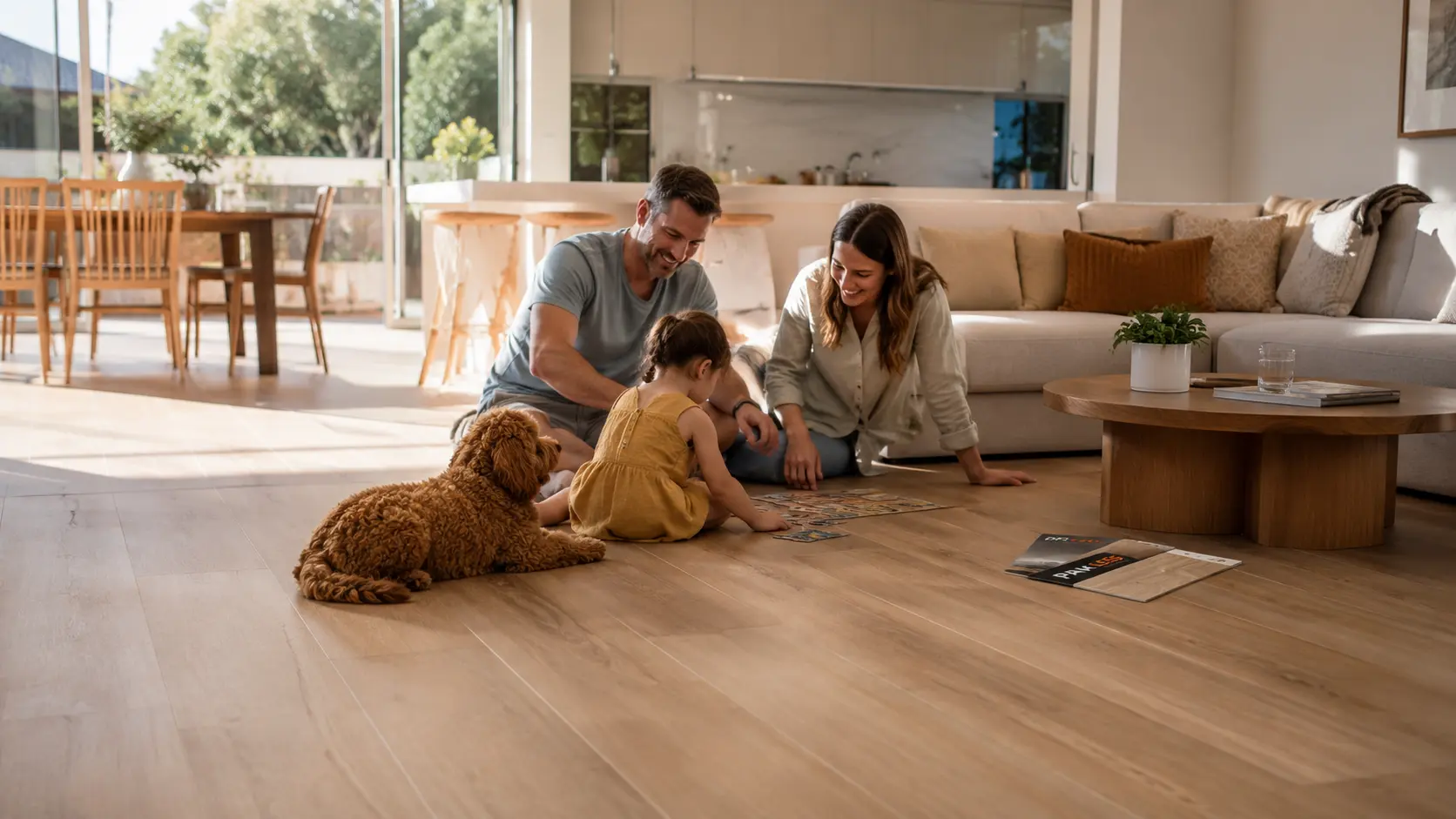
Families with kids and pets
Hybrid wins here almost every time. The fully waterproof core means a knocked-over drink bottle or a dog with wet paws isn’t a crisis, and the scratch-resistant wear layer handles toy trucks, claws, and dining chairs far better than timber or laminate.
Rental and investment properties
Landlords generally do best with hybrid or laminate — both offer strong durability at a lower cost than engineered timber, and both are easy for a property manager to spot-repair between tenancies. We cover this in more depth in our dedicated guide to flooring for rental properties.
Apartments and strata properties
This is less about which flooring and more about how it’s installed. Most strata schemes require an acoustic rating for hard flooring to control noise transfer to the apartment below. Hybrid and laminate floating floors with integrated or added acoustic underlay are the most common compliant solution — always confirm your specific by-laws before ordering. Our guide to flooring for Sydney apartments walks through the by-law, the acoustic rating your scheme will ask for, and what actually gets approved.
Coastal homes in Belrose and the Northern Beaches
Humidity and salt air are real factors here. Hybrid’s waterproof, dimensionally stable core makes it the safest choice for coastal properties, particularly in kitchens, entries, and living areas that catch sea breezes through open doors.
Renovating for resale or long-term value
If you’re renovating to sell, or you simply want the floor that adds the most perceived value, engineered timber is consistently the strongest performer. It reads as a premium, permanent feature in a way that resonates with buyers and valuers.
Tight budget, whole-house renovation
When you’re flooring several rooms at once and cost per square metre adds up fast, laminate is usually the most sensible starting point — you can always upgrade high-use areas like the kitchen to hybrid later.
What About Cost?
Cost is obviously part of this decision, and it deserves more than a one-line answer — different products, thicknesses, and installation complexities change the numbers significantly. We’ve put together a full, Sydney-specific cost breakdown, including labour, subfloor prep, and what actually drives your final quote up or down, in our complete flooring cost guide.
The short version: laminate is typically the most affordable entry point, hybrid sits in the middle with the best durability-to-cost ratio, and engineered timber is the biggest investment — but also the one most likely to hold its value. The only way to get an accurate number for your home is a proper measure — which is exactly what our free measure and quote covers, with no obligation attached.
Five Mistakes Sydney Homeowners Make
We see these come up again and again, usually from homeowners who’ve been burned once already:
- Choosing a colour under showroom lighting only. Take samples home. Look at them in your own morning, midday, and evening light before deciding — showroom lighting flatters almost everything.
- Skipping subfloor preparation to save money. An unlevel or untested subfloor is the single biggest cause of flooring problems down the line, regardless of which product you choose.
- Assuming all “waterproof” claims mean the same thing. There’s a real difference between a fully waterproof hybrid core and a laminate rated for 48-hour spill resistance — know which one you’re actually buying. We’ve unpacked exactly what waterproof does — and doesn’t — cover in is hybrid flooring really waterproof?
- Ignoring strata or body corporate rules until after ordering. Acoustic requirements can affect your product choice and your installation method — check first.
- Matching floor colour too closely to walls or cabinetry. It flattens a room. Aim for at least two to three shades of contrast for a space that still feels considered in ten years.
Why Sydney Homeowners Choose Payless
We’re not going to pretend every flooring company is the same, because the differences show up the day your installer arrives.
- Free measure and quote — an accurate, no-obligation number before you commit to anything
- Expert installation — our own installers, not a rotating cast of subcontractors
- 1-year installation warranty — on top of manufacturer product warranties
- Two Sydney showrooms — Belrose and Castle Hill, so you can see and feel every range in person before you decide
- Competitive pricing without compromising on product quality
If you’d rather see samples in person than scroll through photos, we’d genuinely recommend it — flooring is one of those decisions that’s much easier to make with a plank in your hand than a swatch on a screen.
FAQs
What’s the real difference between hybrid, laminate, and engineered timber?
Hybrid uses a rigid waterproof core, SPC or WPC, with a printed timber-look surface. Laminate uses an HDF core with a printed surface and is more affordable but less water-resistant. Engineered timber uses a genuine hardwood veneer over a plywood core — it’s real wood, just built to be more stable than solid timber.
Which flooring is best for a coastal Sydney home?
Hybrid, in most cases. Its waterproof, dimensionally stable core handles humidity swings better than laminate or engineered timber, making it a safer long-term choice for homes near the coast.
Is hybrid flooring worth the extra cost over laminate?
For busy households, kids, pets, or anywhere near water, yes — the fully waterproof core and stronger scratch resistance tend to pay for themselves in fewer repairs and replacements over time. For the full head-to-head, see our hybrid vs laminate flooring guide
What flooring is best for apartments with strata rules?
Hybrid or laminate floating floors with acoustic underlay are the most common compliant option, but always check your specific building’s by-laws before ordering — acoustic ratings vary between schemes. The full process is set out in our apartment and strata flooring guide.
How long does new flooring last?
Laminate typically lasts 15–25 years, hybrid performs similarly with proper care, and engineered timber can last several decades, particularly if it’s refinished when the surface starts to show wear.
Can you install new flooring over my existing tiles or floorboards?
Often, yes — floating floors like hybrid and laminate can frequently go directly over existing hard flooring, which reduces cost and mess. It depends on the condition and level of your current floor, which is exactly what we check during your free measure.
How much does flooring cost in Sydney?
It depends on the product, the size of the space, and any subfloor preparation required. Read our full flooring cost guide for a detailed breakdown, or book a free measure and quote for an exact number.
Ready to See These Ranges in Person?
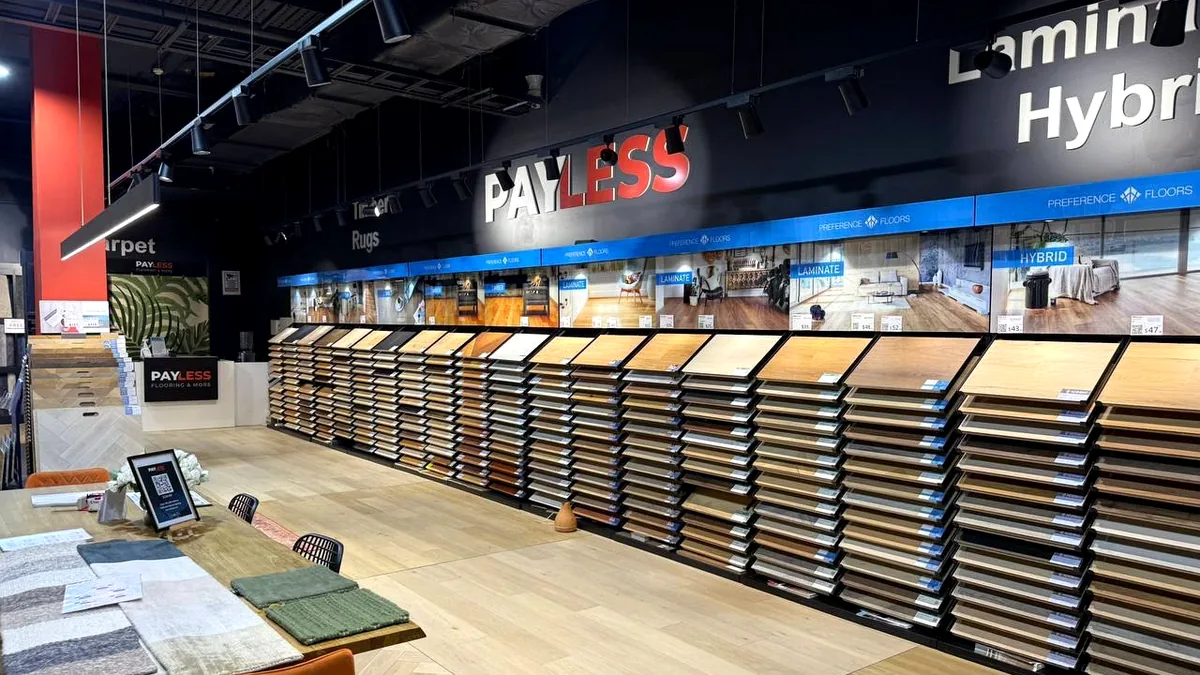
Photos only tell you so much. Book a free measure and quote, or visit our showroom in Belrose or Castle Hill to see, touch, and compare hybrid, laminate, and engineered timber side by side.