
Most people choose carpet with their hands. You walk into a showroom, run a palm across a dozen samples, and the softest one wins. It is the most natural way to shop for carpet and it is also the most expensive habit in the category, because softness underfoot and resistance to being walked on twelve times a day are close to opposites. The sample that feels best on a display stand is very often the one that flattens first in your hallway.
The good news is that carpet is a genuinely solvable problem. There are only three decisions that matter — fibre, pile and underlay — and once you have made those three honestly, the colour choice is the fun part rather than the risky one. This guide walks through all three with real Sydney numbers, and is upfront about where carpet is the wrong answer.
The Quick Answer
If you want the shortlist before the reasoning:
| Your situation | What usually suits | Why |
|---|---|---|
| Family home, kids and pets | Solution-dyed nylon | Colour is locked into the fibre, so it survives cleaning and sunlight; it also recovers from furniture compression |
| Bedrooms only, comfort first | Wool, or a soft nylon | Low traffic means you can buy for feel rather than resilience |
| Stairs and hallways | Solution-dyed nylon on high-density rubber underlay | The highest-wear surfaces in the house, and the ones that fail first |
| Investment property or rental | Budget-to-mid synthetic | Durable mid-grade beats premium in a rental — you are buying tenancy cycles, not a lifetime |
| Apartment or strata | Carpet, on the underlay the scheme specifies | Carpet clears acoustic by-laws with the least paperwork of any floor covering |
| Whole home on a budget | Carpet in bedrooms, hard flooring through living zones | Mixing usually beats any single-product budget |
Why Carpet Is a Different Decision in Sydney
Most carpet advice online is written for a national audience, or quietly for Melbourne. Four things make Sydney its own problem.
Coastal humidity. Homes around Belrose, Dee Why and the Northern Beaches sit in air that carries salt and moisture most of the year. Carpet handles that better than timber does — it does not swell or cup — but the underlay underneath it matters more, because a cheap foam sitting on a damp slab is where the smell starts.
Slab-on-ground construction. Much of the Hills District and the newer western suburbs are built on concrete slabs, and moisture in a slab moves upward. On a ground floor, the underlay and the slab check are not optional extras. On a suspended timber floor upstairs, they matter much less.
Apartments. Sydney has some of the highest apartment density in the country, and most strata schemes set acoustic requirements for flooring. Hard floors can comply, but the approval depends on the complete tested system and it takes paperwork. Carpet is the path of least resistance — which is a large part of why bedrooms in Sydney apartments are still carpeted even in homes that went hybrid everywhere else.
Labour costs. Sydney metro installation runs 15–20% above regional NSW and the smaller capitals. Any per-metre figure you read on a national site needs that added before it means anything here.
Decision One: The Fibre
This is 80% of the outcome. Everything else is refinement.
| Fibre | Installed, Sydney | Realistic lifespan | The honest read |
|---|---|---|---|
| Budget synthetic (polyester, polypropylene) | $40–70 /m² | 5–10 years | Cheapest to buy, flattens under heavy traffic. Right for spare rooms and rentals, wrong for a hallway |
| Solution-dyed nylon | $65–110 /m² | 12–15 years | The modern default: durable, fade-resistant, bounces back from furniture. Where most family homes should start |
| Wool | $80–250 /m² (most jobs $90–150) | 15–25 years | Natural insulation and the best feel underfoot. Premium, and worth it in rooms where you notice it |
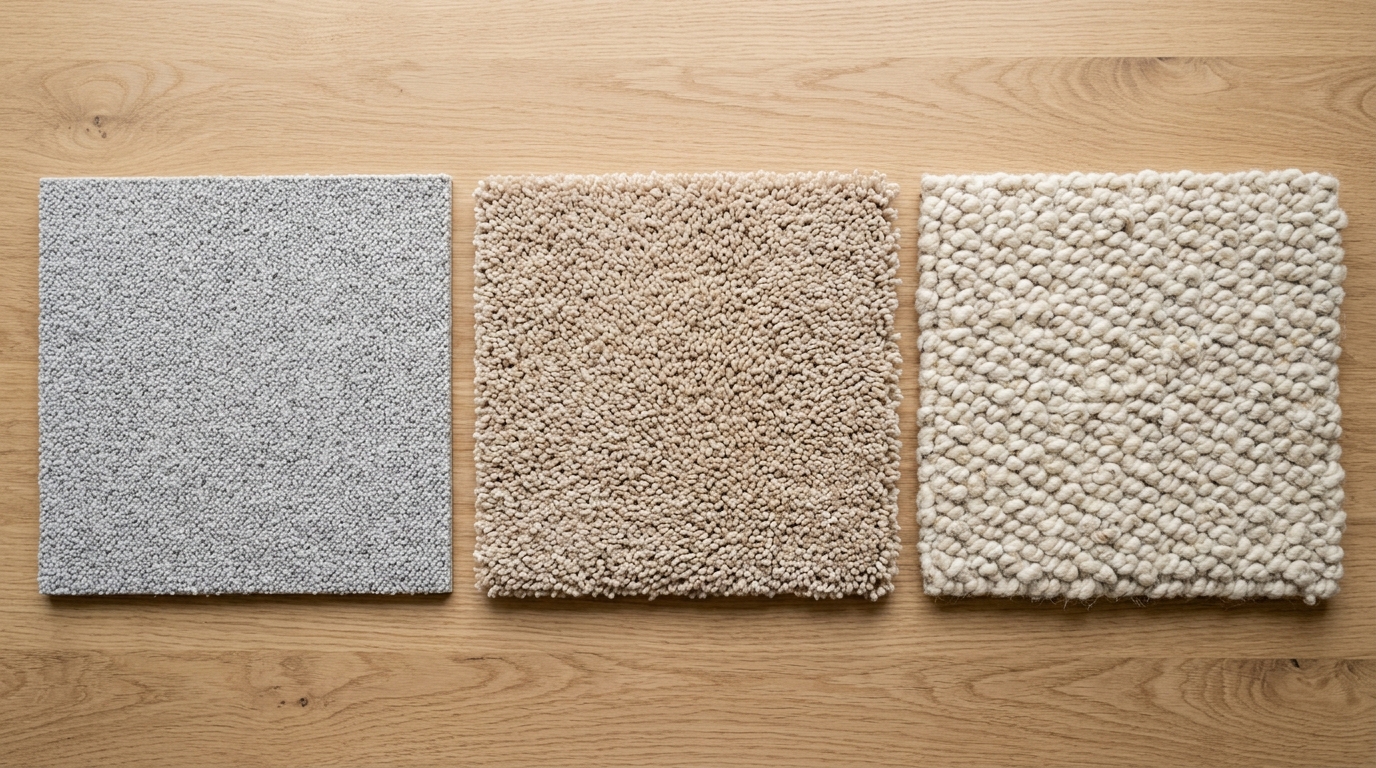
Solution-dyed nylon, and why the “solution-dyed” half matters
Nylon is the toughest of the common carpet fibres, but the more useful word in that phrase is the first one. In a conventionally dyed carpet the colour is applied to the outside of the fibre. In a solution-dyed carpet the pigment is mixed into the liquid polymer before the fibre is even formed, so the colour runs all the way through, like a stick of rock.
The practical consequence is that it does not fade in a sun-facing room and it survives aggressive cleaning — including the kind you need after a dog, a toddler or a spilled glass of red. If you have north-facing living areas and a family, this is the single spec that earns its money.
Our synthetic carpet range covers nylon alongside polyester and triexta. A dedicated comparison of nylon against polyester and triexta is coming soon on this blog.
Wool
Wool is the only fibre here that was not invented. It insulates, it holds its shape, it is naturally flame-resistant, and it feels different underfoot in a way that is difficult to argue with once you have stood on it barefoot. It also holds a dye beautifully, which is why the deepest carpet colours tend to be wool.
The honest limitation: wool is more vulnerable to staining than solution-dyed nylon, and it costs more. The way most Sydney homes resolve that is by buying wool where it is felt and nylon where it is walked on — wool in the master bedroom, nylon down the hallway and stairs. Nobody sees the join and the budget survives. You can see the range on our wool carpet page, and a full wool-versus-synthetic comparison is coming soon on this blog.
Polyester and triexta
Polyester is soft and takes colour well at a low price, and it is genuinely stain-resistant — but it is less resilient than nylon, meaning it crushes flat under traffic sooner. Triexta sits between the two: softer than nylon, more resilient than polyester, and generally priced accordingly. Both are legitimate choices in bedrooms and spare rooms. Neither is what you want on a staircase.
Decision Two: Pile and Construction
Pile is how the yarn is attached and finished, and it decides how the carpet wears and how it hides things.
- Cut pile — the yarn loops are cut, leaving upright tufts. Softer, warmer, and what most people picture when they picture carpet. Plush cut piles show footprints and vacuum marks; tighter twist piles do not.
- Loop pile — the loops are left intact. Harder-wearing and better at disguising traffic lanes, which is why it turns up in hallways and offices. Loops can be pulled by pet claws, which is the trade-off.
- Twist — a cut pile with the yarn tightly twisted before heat-setting. The most common all-rounder in Australian homes and usually the safest single answer.
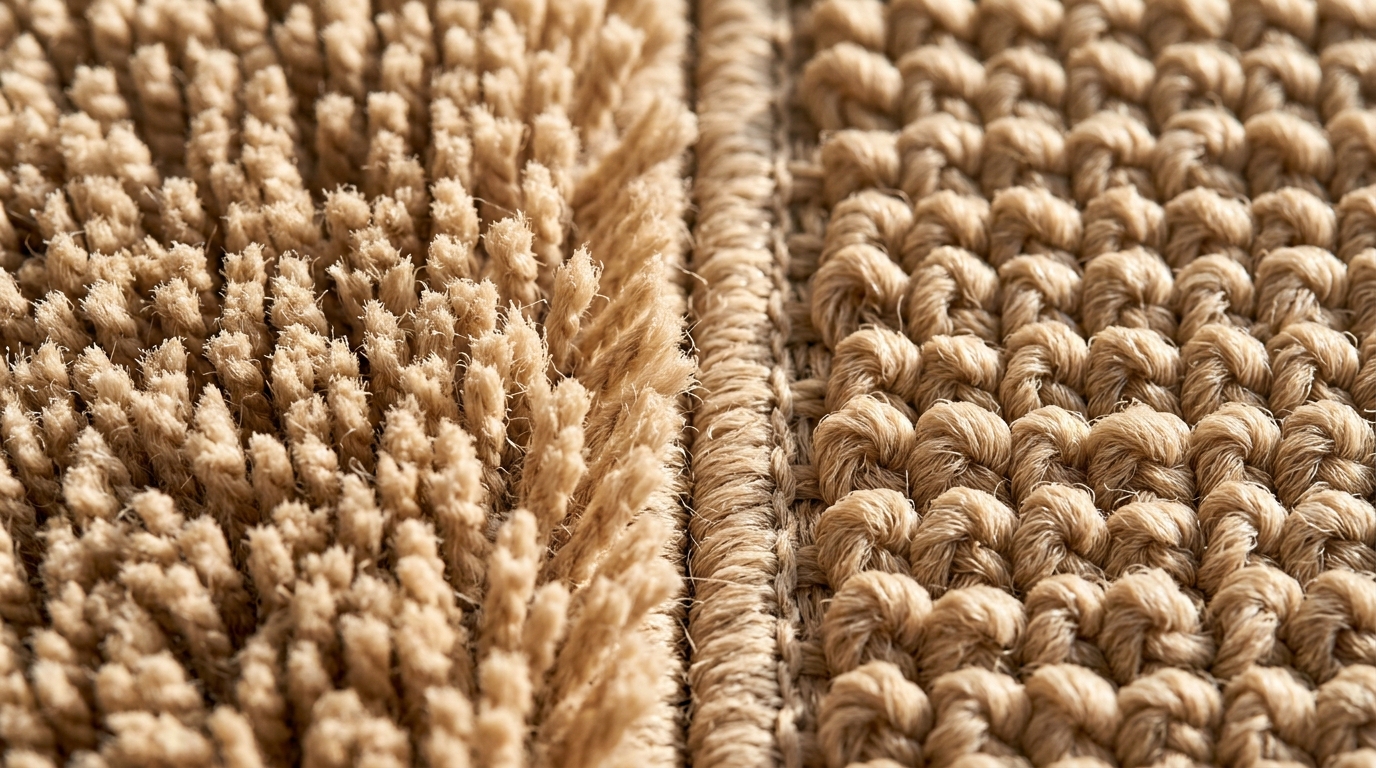
The rule that matters more than the category name is density. Push your thumb into the sample and try to feel the backing through the pile: the harder that is, the more fibre is packed in, and the longer the carpet will hold its shape. A dense mid-price carpet will outlast a plush expensive one in a hallway every time. A full guide to cut pile against loop pile is coming soon on this blog.
Decision Three: Underlay — The Half of the Job You Will Never See
Carpet underlay runs $8–25/m² installed, and it is the line people cut when a quote comes back higher than they hoped. It is almost always the wrong line to cut.
Underlay does three jobs: it absorbs the impact of every footfall so the carpet fibre does not take it, it adds the softness people think they are buying in the carpet, and on a ground-floor slab it forms part of the moisture defence. Premium carpet on cheap underlay feels like walking on concrete, and it wears out early — you are effectively spending the carpet budget twice.
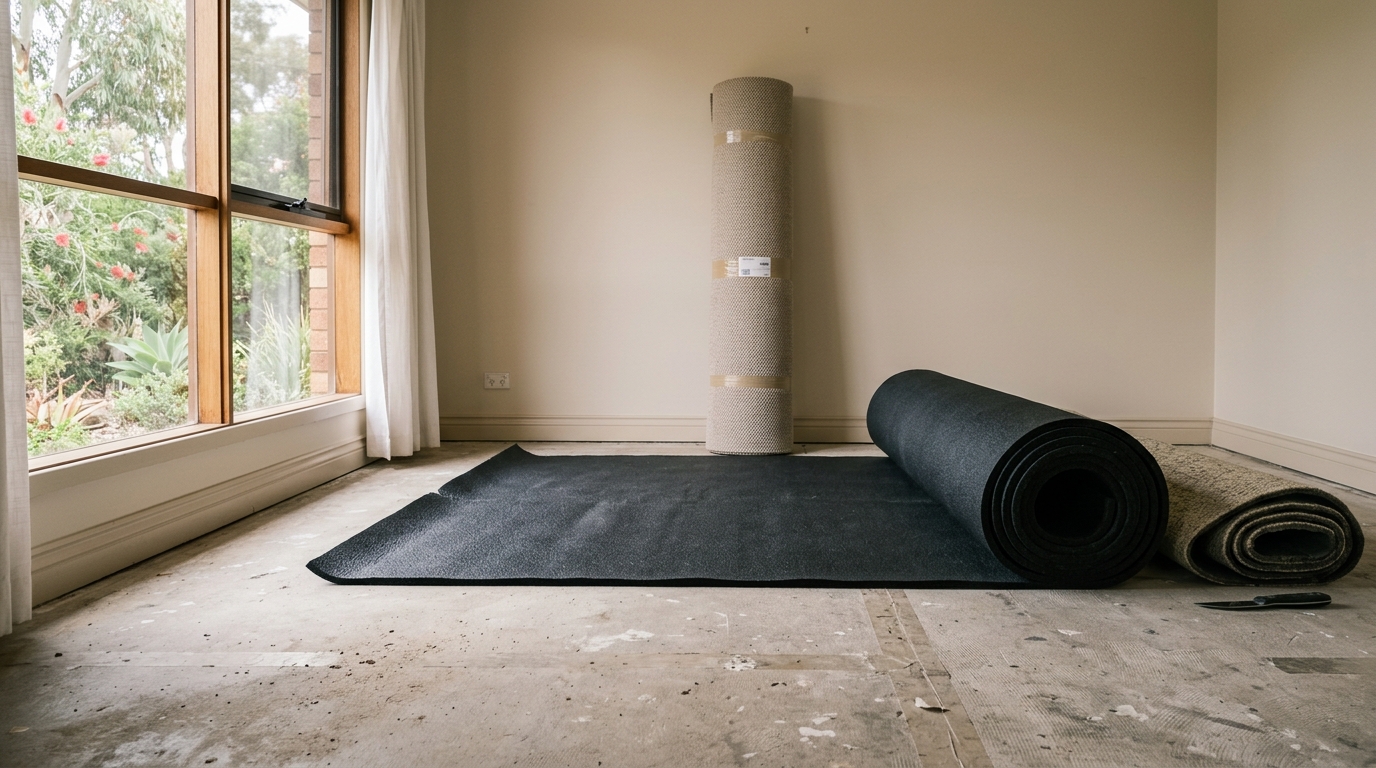
For stairs and hallways, high-density rubber underlay at $15–20/m² is the specification to insist on. Those are the surfaces that fail first, and the underlay is what decides when. A dedicated carpet underlay guide is coming soon on this blog.
What Carpet Actually Costs in Sydney
All figures are supplied and installed, including standard underlay and trims. Subfloor preparation and old-floor removal are extra. Carpet is also rarely bought on its own — most of these jobs are half a house, so it is worth knowing what every other floor costs in Sydney before you settle the budget.
| Room or home | Area | Budget synthetic ($40–70) | Solution-dyed nylon ($65–110) | Wool ($90–150) |
|---|---|---|---|---|
| Standard bedroom | 12 m² | $480 – $840 | $780 – $1,320 | $1,080 – $1,800 |
| Living + dining | 30 m² | $1,200 – $2,100 | $1,950 – $3,300 | $2,700 – $4,500 |
| Three bedrooms + hallway | 45 m² | $1,800 – $3,150 | $2,925 – $4,950 | $4,050 – $6,750 |
| Whole home (3-bed) | 100 m² | $4,000 – $7,000 | $6,500 – $11,000 | $9,000 – $15,000 |
These figures are calculated on floor area. The extra carpet that roll width forces you to buy is already allowed for in the installed rate — which is why the rate is quoted per square metre of room, not per square metre of roll.
Two things move those numbers. Jobs over about 80 m² attract a better per-metre rate, so carpeting the whole house at once costs less per metre than doing it a room a year. And a single small room prices above the per-metre rate, because call-out, setup and trims do not shrink with the floor area.
Stairs are quoted separately at $80–140 per step, supply and labour combined — a typical 13 to 14 step Sydney staircase runs $1,040–1,960 on top of the floor area. Removing and disposing of old carpet is $15–35/m².
The roll-width detail that explains quote differences
Carpet comes off a roll 3.66 m wide, and you pay for the carpet that has to be cut rather than the floor you can see. A 4.0 × 3.0 m bedroom is 12 m² of floor, but the roll has to run the full 4.0 m length at its full 3.66 m width — about 14.6 m² of carpet — and the offcut is not usable anywhere else.
This is why two carpet quotes for the same house can differ by 15% before anyone has discussed the carpet itself. Whoever plans the roll layout more carefully wastes less of it. It is also why carpet quotes should be compared on the total, never on the per-metre rate alone.
Cheapest for how long?
The per-metre price tells you what a floor costs to buy. Divided by an honest lifespan, it tells you what it costs to own.
| Product | Installed price | Lifespan | ≈ Cost per m² per year |
|---|---|---|---|
| Budget synthetic carpet | $40–70 /m² | 5–10 years | $4–14 |
| Solution-dyed nylon carpet | $65–110 /m² | 12–15 years | $4.30–9.20 |
| Wool carpet | $90–150 /m² | 15–25 years | $3.60–10 |
| Laminate | $60–80 /m² | 15–25 years | $2.40–5.30 |
| Hybrid | $65–85 /m² | 15–25 years | $2.60–5.70 |
| Engineered timber (re-sanded once) | $140–180 /m² | 30–40 years | $3.50–6.00 |
Method: low price ÷ longest lifespan gives the low end; high price ÷ shortest lifespan gives the high end, using the “most jobs land at” price band for each product. Lifespans are estimates, so read these as comparative bands, not precise figures.
Read that table honestly and budget synthetic carpet is frequently the most expensive floor in the house, because you buy it twice in the time wool is bought once. It is still the right answer in a rental between tenancies — the calculation there is tenancy cycles, not decades. A deeper carpet-only cost breakdown is coming soon on this blog.
Room by Room
Bedrooms
Low traffic, bare feet, and the one room where comfort genuinely outranks durability. This is where wool earns its premium, and where a softer nylon or a good triexta is a sensible compromise. A dedicated guide to the best carpet for bedrooms is coming soon on this blog.
Stairs and hallways
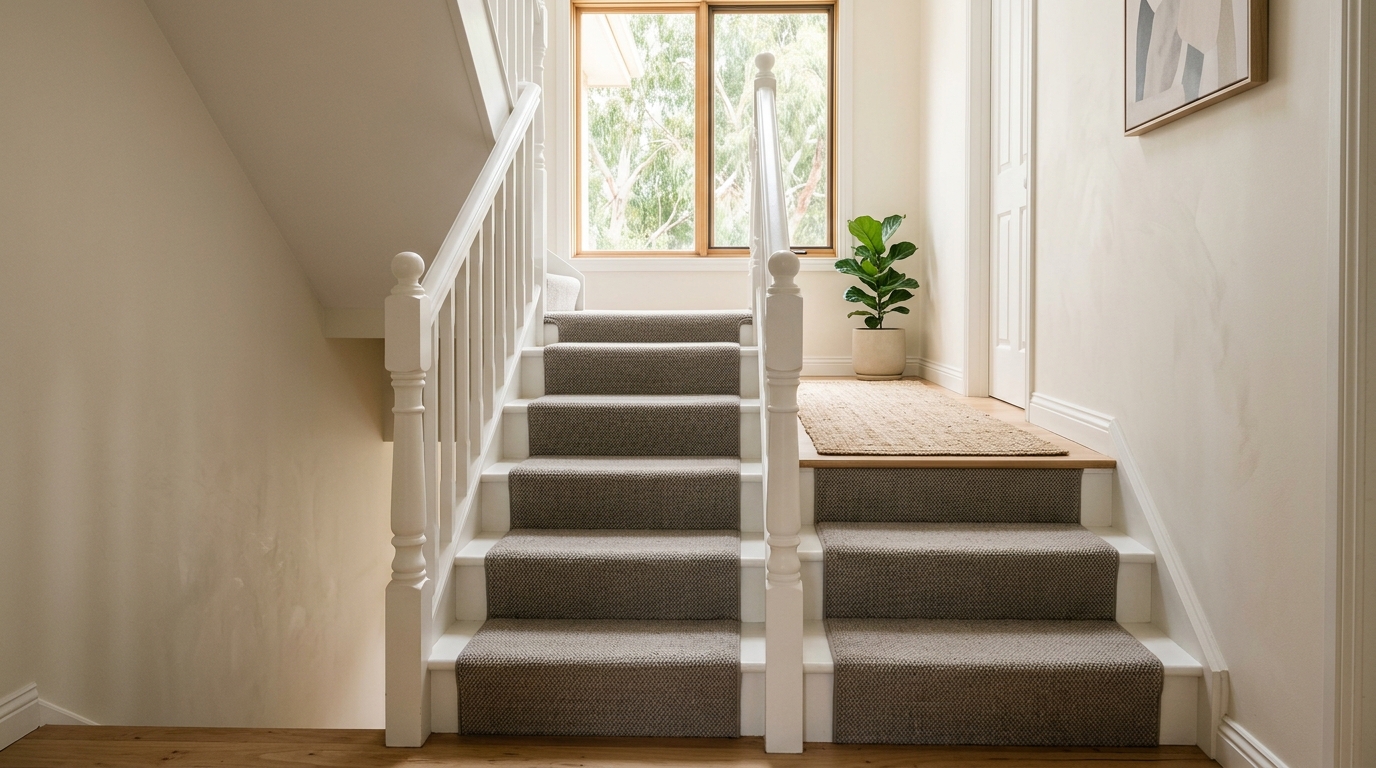
The opposite brief. Every trip through the house concentrates on these surfaces, and stair nosings take the impact at a single point. Solution-dyed nylon, a tight twist or loop construction, and high-density rubber underlay. Do not carry the bedroom carpet onto the stairs to keep the look consistent — it is the most common way people end up recarpeting in six years instead of twelve. A full guide to carpet for stairs and high-traffic areas is coming soon on this blog.
Living areas
Sydney homes increasingly run hard flooring through living zones and keep carpet in the bedrooms, which handles spills, pets and resale in one decision. If you want carpet in a lounge room, choose for the furniture as much as the feet: heavy sofas leave compression marks that resilient fibres recover from and cheap ones do not.
Where carpet is not the answer
Kitchens, laundries, entries and bathrooms. Water and carpet have no shared future, and no fibre treatment changes that. Those rooms want a hard floor — our guide to choosing flooring for a Sydney home covers the options, and where hybrid handles water and where it needs care is the honest version of the waterproofing question.
Carpet With Kids and Pets
Three specifications do most of the work: solution-dyed nylon so the colour survives cleaning, a mid-tone flecked or textured colour so the carpet is not a scoreboard, and a loop-free construction if you have a cat, because claws pull loops.
The unglamorous one people skip: a proper doormat at every external door. Most carpet wear is abrasive soil walked in from outside, and the first metre of carpet past a door takes the worst of it.
How to Read a Carpet Quote
- Is underlay a separate, named line? With a type and a thickness, not just the word “underlay”. If it is not there, it is either buried in the rate or genuinely missing.
- Does it mention power-stretching? A quote that names power-stretching and AS/NZS installation standards is written by people who install carpet properly. Stretched-in carpet stays flat; carpet laid without it ripples within a year or two.
- Is the m² figure the carpet or the floor? It should be the carpet, and it should be more than the floor area. Ask which.
- Is removal and disposal of the old carpet included? That is $15–35/m² and it is a common omission in the cheaper of two quotes.
- Are stairs priced separately? They should be, at a per-step rate.
A quote without these lines itemised is not cheaper — it is just incomplete.
Five Mistakes Sydney Homeowners Make With Carpet
- Choosing by softness in the showroom. Press for density instead. The softest sample on the stand is rarely the one you want in a hallway.
- Saving money on underlay. It is the cheapest way to shorten the life of an expensive carpet.
- Comparing per-metre rates instead of totals. Roll width and layout planning can move the total 15% with the same carpet.
- Using one carpet everywhere. Bedrooms and stairs have opposite requirements; buying one compromise for both means over-paying in one room and under-specifying in the other.
- Ignoring the slab on a ground floor. Moisture rises, and it is the underlay and the pre-installation check that deal with it — not the carpet.
Why Sydney Homeowners Choose Payless
We install with our own team rather than subcontractors, which is why we can put a 1-year installation warranty on every job. The measure and quote is free and carries no obligation. And we have two showrooms where you can put your hand and your foot on the actual product — Belrose for the Northern Beaches and the north, Castle Hill for the Hills District — because no photograph has ever communicated what a carpet feels like.
Frequently Asked Questions
What is the best carpet for a Sydney home?
For most family homes, solution-dyed nylon at $65–110/m² installed. The colour is locked into the fibre so it survives sunlight and cleaning, and it recovers from furniture compression. Wool is the upgrade where comfort matters most — typically bedrooms — and budget synthetic makes sense in rentals and spare rooms.
How much does carpet cost in Sydney?
Between $40 and $250/m² supplied and installed, depending on fibre. Budget synthetic runs $40–70/m², solution-dyed nylon $65–110/m², and wool $80–250/m² with most wool jobs landing at $90–150/m². A 100 m² home is roughly $6,500–11,000 in nylon or $9,000–15,000 in wool.
Is wool carpet worth the extra cost?
In the rooms where you notice it, usually yes — wool lasts 15–25 years against 12–15 for nylon, so per year of service it is often the cheaper carpet. In a hallway with a dog and two kids, solution-dyed nylon is the better buy despite the shorter life, because it takes cleaning that wool does not.
Do I need new underlay when I replace my carpet?
Almost always. Underlay compresses over its life, and a new carpet laid on ten-year-old underlay inherits a floor that has already done its cushioning. It is $8–25/m² and it is the difference between the new carpet feeling new and feeling like the old one.
Can I put carpet in a Sydney apartment?
Yes, and it is generally the easiest flooring to get approved. Most strata schemes set acoustic requirements that carpet meets comfortably, where hard flooring needs the complete system tested and documented. Check your by-laws for any specified underlay before ordering.
How long does carpet last?
Budget synthetic 5–10 years, solution-dyed nylon 12–15, wool 15–25. Those assume correct underlay and professional installation — carpet that was not power-stretched will ripple and wear unevenly well before the fibre is finished.
Do you supply carpet for offices and commercial projects?
Yes, but it is a different product set and a different conversation — carpet tiles, commercial broadloom and Axminster, specified for traffic ratings rather than living rooms. That side of the business lives on our commercial flooring page.
See and Feel the Difference
Carpet is the one floor covering you genuinely cannot judge from a screen. Density, spring and how a colour reads in daylight are all things your hand tells you in about four seconds.
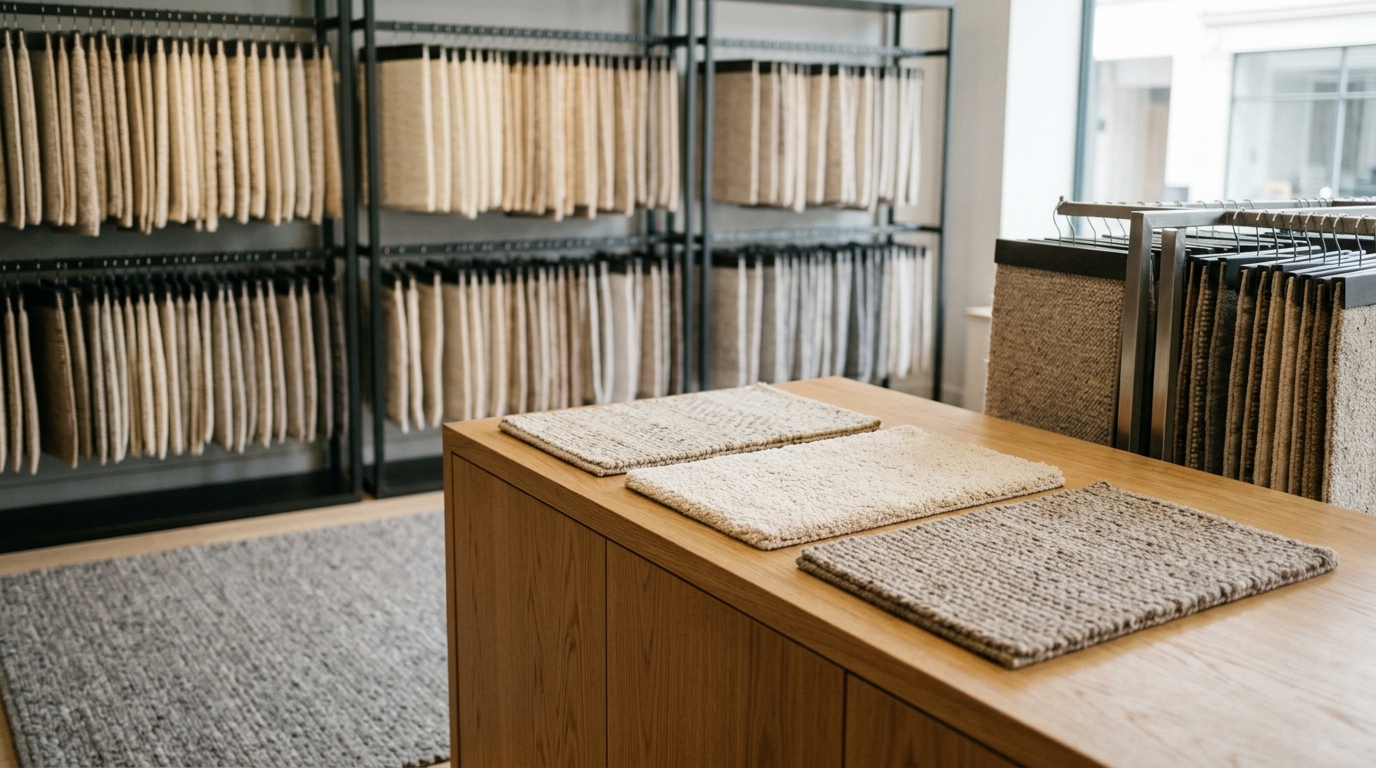
Browse our wall-to-wall carpet range, then book a free measure and quote and we will bring samples to your rooms, in your light, and give you an itemised price with no obligation.
Or visit us: Belrose Shopping Centre, Shop 1.10 (02 9486 3502) or Hills Super Centre, Shop 85B, 16 Victoria Ave, Castle Hill (02 8606 4840).