
The question usually arrives in the middle of a refurbishment: the designer has specified Axminster. So what is Axminster carpet, and is it just an expensive word for patterned carpet?
No. Axminster is a weave, not a pattern. The tufts are woven in and locked by the backing yarn as the carpet is made, rather than needled into a ready-made backing and held there with latex. That one difference is why a venue carpet can carry a detailed design, and why it can outlast a tufted carpet by many years on a hospitality floor.
It is also why it is slow and expensive, and why it is the wrong product for a lot of the venues that ask about it. Both halves are below.
Woven, Not Glued, and Why the Failure Mode Matters
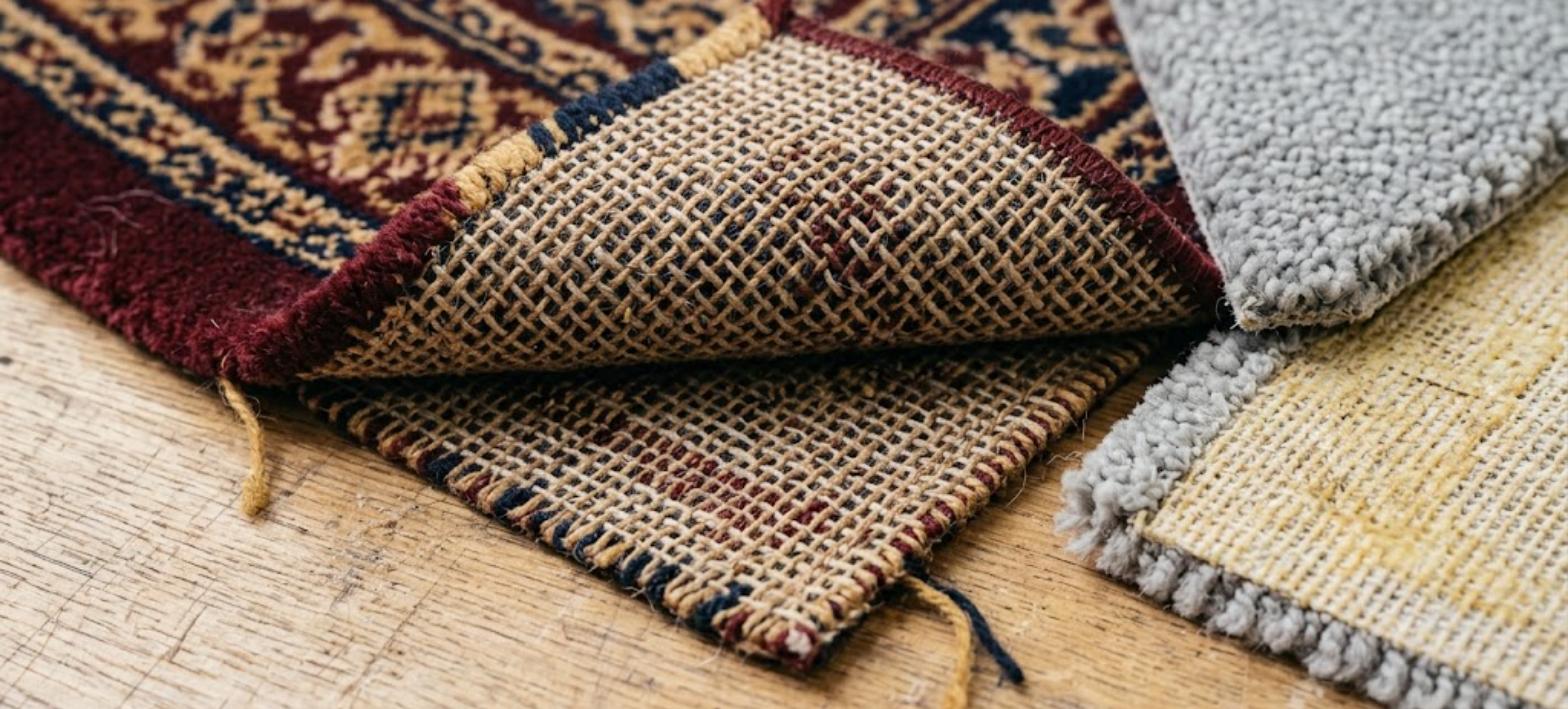
A tufted carpet is made by punching yarn through a primary backing and gluing a secondary backing on behind it. It’s fast, it’s most of the carpet market, and it’s a perfectly good product. Its end of life is usually delamination: the latex bond between the two backings breaking down, so the carpet ripples, the seams open and the pile releases.
An Axminster has no such bond to fail. Each tuft is woven and locked in place by shots of backing yarn, which produces a three-dimensional structure rather than two layers held together. There is nothing to delaminate.
The practical consequence for a venue isn’t “it feels better”. It’s that the carpet fails by looking tired rather than by coming apart, and appearance loss is a slower, more predictable thing to budget for than a floor that has to come up.
The Blend: 80/20
The hospitality standard is 80% wool, 20% nylon, and it is still the default.
The reason it survived is that each fibre covers the other’s weakness. Wool crushes less, recovers its pile, resists soiling and is naturally flame resistant; nylon takes the abrasion. Drop the nylon and the carpet wears through in the traffic lanes. Drop the wool and you lose the recovery and the feel that a venue is paying for in the first place.
If a quote says “wool blend” without the ratio, ask for the number. It’s the spec most often left vague.
What “Pitch × Rows” Means, and the Number to Ask For
Carpet salespeople quote pile weight because it sounds like a lot. On a woven carpet the more useful number is the stitch rate (pitch × rows): how many tufts across, and how many rows per inch along the length.
- 7 × 8 is a common hospitality specification
- 7 × 9 and above is what you specify for fine pattern detail, or for a floor taking exceptional traffic
- 9 and 10-row constructions exist for the heaviest-traffic areas; 7/8-row is the lower-traffic spec
Higher rows means more yarn in the same square metre, finer pattern definition, and more money. A detailed design woven at too low a stitch rate comes back looking blurred, and there is no fixing it afterwards.
Colour: Far More of It
This is the capability no other carpet construction gives you at scale. A modern electronic jacquard Axminster can carry many colours in a single design, far more than a tufted carpet. Wilton (the other woven family, and the one people confuse it with) typically runs fewer.
That’s why patterned venue carpet is almost always Axminster. A busy, multi-colour design isn’t decoration for its own sake in a pub or a club: it disguises the soiling and spills a plain carpet advertises, it defines zones on an open floor without walls, and it reads as a finished room rather than a floor covering.
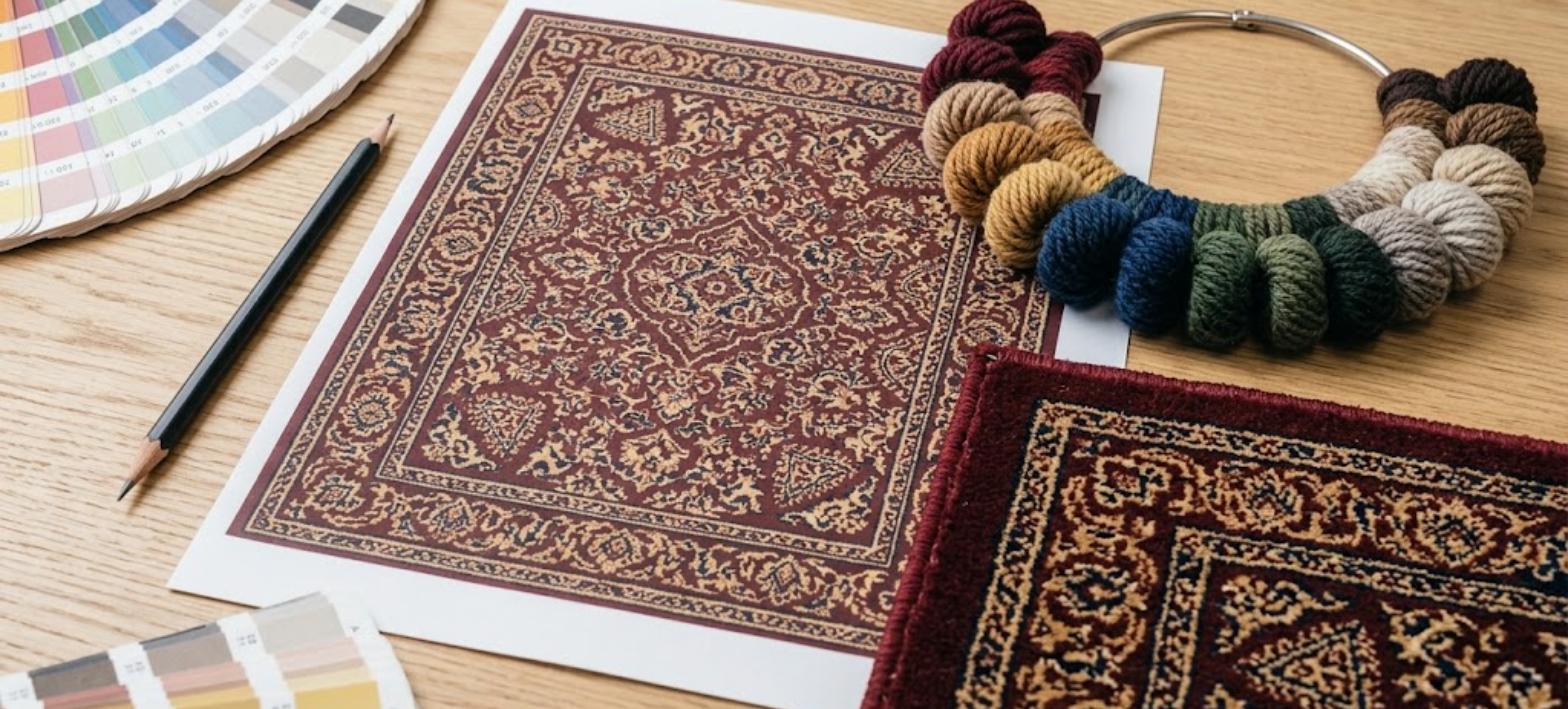
The Custom Design Process, in Weeks
This is where most venue projects are won or lost, and it is almost never in the quote.
| Stage | Time |
|---|---|
| Design and sampling | 3–4 weeks |
| Manufacture and shipping | about 12 weeks |
| Total from artwork approval | about 16 weeks |
And there’s a floor under the whole thing: a custom design typically needs a minimum run, commonly in the hundreds of square metres depending on the mill, to be made at all. Below that, nobody is setting up a loom for you.
Two things follow from that table. The clock starts at artwork approval, not at the order. Every round of “can we see it in a different blue” is a week. And if your reopening date is eight weeks away, custom Axminster is not the product. A stocked design ships in a fraction of that time, and there are good ones.
How It’s Priced
Axminster is sold by the broadloom metre: one linear metre off a 3.66 m wide roll, which is 3.66 m². Price moves with the stitch rate, the wool content, the design and the quantity, so a venue job is quoted per project once the artwork and the floor plan are settled.
The broadloom metre is also the unit that catches people out, because you pay for the full 3.66 m of width whether your room uses it or not. How the rolls are laid out across the room decides how much of that you buy, which is why the seam plan belongs in the quote.
Fire, and the One Number That Applies
A pub, club or function room is a Class 6 or Class 9b building under the National Construction Code, and the floor covering has to meet the same critical radiant flux minimum as any other commercial floor: 2.2 kW/m² without sprinklers, 1.2 kW/m² with them, tested to AS ISO 9239.1, plus a maximum smoke development rate of 750 %·min in unsprinklered buildings.
Wool’s natural flame resistance means a proper 80/20 Axminster usually clears this, but the certificate still has to exist, and a certifier will ask for it. Any proper hospitality range publishes the figure.
Installation: The Part That Decides Whether It Lasts
A woven carpet is heavy, it has a pattern that must match across seams, and it is unforgiving of a bad subfloor. Installation of textile floor coverings in Australia is covered by AS 2455.1:2019, Textile floor coverings, Installation practice, Part 1: General.
If a quote names the fixing method (stretched over underlay, or glued down) and the AS 2455 standard, you’re dealing with installers who do this properly. If it doesn’t, ask why. Pattern match across a 3.66 m seam is not something you can negotiate after the fact.
The Part That Costs Us Money
Most venues that ask about Axminster shouldn’t buy it.
If you run a 60 m² bistro, or a club room you refit every five years, the minimum order alone rules a custom design out, and paying for a long-life carpet on a five-year plan is money spent on a life you’ll never use. A stocked commercial design, or a heavy-duty commercial tufted broadloom, will do the job and leave budget for the things that actually wear a floor out: entry matting, and a properly prepared subfloor.
Axminster earns its money in one situation: a large floor, a long horizon, and a design that has to look like the venue’s own. A club auditorium, a hotel corridor and guestroom package, a function room that hosts four hundred people a week. Those floors justify the weave, the wait and the price. A small room on a short lease does not, and we’ll tell you so at the measure rather than after the deposit.
Frequently Asked Questions
Is Axminster better than tufted carpet?
For a venue floor with a patterned design and a long life expectancy, yes. It can outlast a tufted carpet by many years in hospitality use, and it has no latex bond to delaminate. For a small room, a short lease or a plain colour, tufted is the sensible buy and Axminster is over-specification.
What is the difference between Axminster and Wilton?
Both are woven. Axminster carries far more colours in one design, which is why it dominates patterned hospitality work. Wilton typically runs fewer colours, with the yarn carried through the backing.
How long does a custom Axminster take?
Typically about sixteen weeks, depending on the mill, from artwork approval: roughly 3–4 weeks of design and sampling, then about 12 weeks of manufacture and shipping. Build that into the refurbishment programme before the trading dates are locked in.
Can we get a small quantity of a custom design?
Generally no. Custom runs need a minimum quantity, commonly in the hundreds of square metres depending on the mill. Under that you’re choosing from stocked designs, which isn’t a downgrade, just a smaller catalogue.
Does Axminster have to be wool?
No, but the hospitality standard is 80% wool and 20% nylon, and there’s a reason it’s still the default. Solution-dyed nylon Axminsters exist and are cheaper; they abrade well and they feel like what they are.
Get It Specified Properly
If you’re refurbishing a venue, the useful conversation isn’t “how much is Axminster”. It’s what the floor has to do, over how many years, on what programme, because that decides whether you’re ordering a custom weave in February for a September reopening, or choosing from stock next week.
Bring the plans and the dates into Castle Hill (Hills Super Centre, Shop 85B, 16 Victoria Ave South Building, 02 8606 4840) or Belrose (Belrose Shopping Centre, Shop 1.10, 02 9486 3502), or book a free site measure and quote and we’ll come to the venue. Our commercial flooring page has the range, samples are in both showrooms, and our own installers do the work, with a one-year warranty on every installation. For the same decisions across offices, retail and strata, see our guide to choosing commercial flooring.