
No floor is both scratch-proof and soft underfoot. That’s the whole problem with asking for the best flooring for pets and kids, and it’s why the honest answer for a Sydney family with kids and a dog isn’t a product. It’s a plan for the house. Hybrid through the kitchen, entry and living zones; solution-dyed nylon carpet in the bedrooms. That combination handles spills, claws and noise better than any single floor laid wall to wall, and it usually costs less than doing the whole house in one premium product.
The Short Answer, by Zone
| Zone | What we’d lay | Why |
|---|---|---|
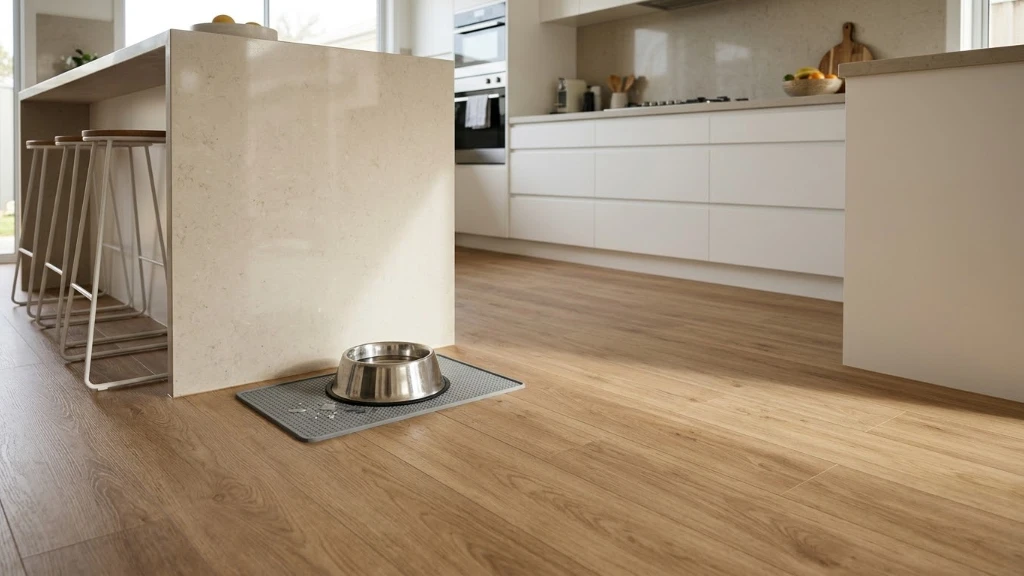
| Kitchen, laundry, entry | Hybrid | Waterproof core (subject to product and warranty conditions) and a wear layer you can specify for heavy use. Water bowls and wet shoes live here |
| Living and dining | Hybrid, or engineered timber | Hybrid resists the damage; engineered timber can be sanded when it happens. Both defensible |
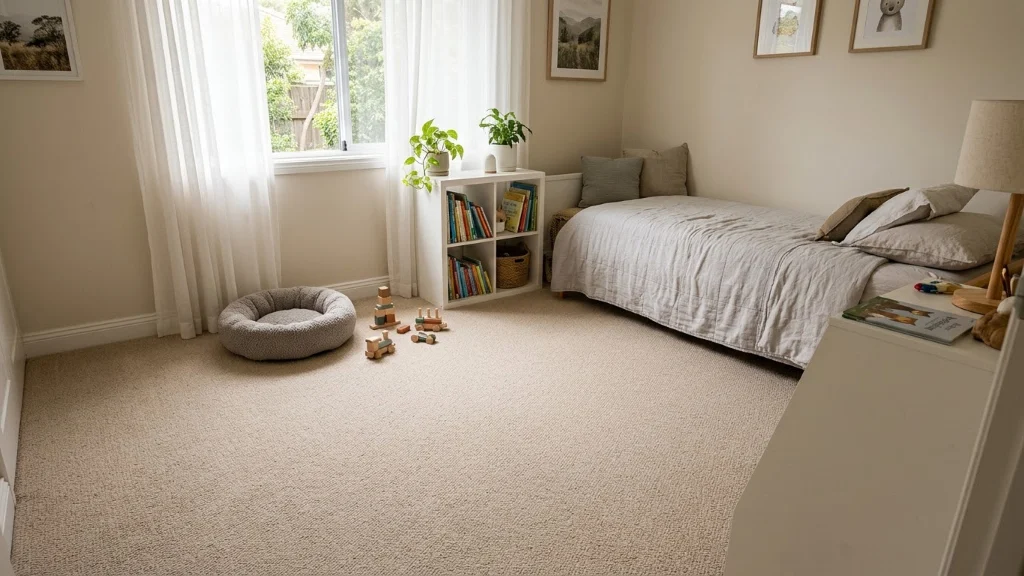
| Bedrooms | Solution-dyed nylon carpet | Warm, quiet, forgiving on knees and paws. Fade-resistant and springs back from furniture legs |
| Hallways and stairs | Hybrid, or nylon on high-density rubber underlay | These fail first in every house. Whatever goes here has to be the hardest-wearing thing you buy |
| Bathrooms | Neither: tile | Wet-area waterproofing lives in the substrate under AS 3740, not in the floor covering |
Our complete guide to choosing flooring for your Sydney home works through all six household situations.
“Pet-Proof” Is Marketing. The Spec Is a Number
Every flooring brand in Australia claims its product handles pets. The claim is worth nothing on its own. The specification underneath it is worth a great deal, and it takes ten seconds to read off a quote.
For hybrid, the number is the wear layer: the clear protective film on top, commonly 0.3 mm to 0.7 mm depending on the product. It predicts how the floor ages better than total plank thickness does. A 0.3 mm wear layer is fine for a spare bedroom and undersized for a family kitchen with a labrador in it. Our hybrid range runs from Easi-Plank at 0.5 mm to Aspire at 0.7 mm.
For laminate, it’s the AC rating: AC3 is residential, AC4 heavy residential, AC5 commercial. It matters more than thickness. An 8 mm AC4 board in a bedroom will outlast a 12 mm AC3 board in a hallway. With kids and pets, AC4 is the floor of the range, not the ceiling.
Two planks that look identical in a photo can be built to very different specifications. Ask for the number, not the adjective.
Scratches: The Trade-off Nobody Names
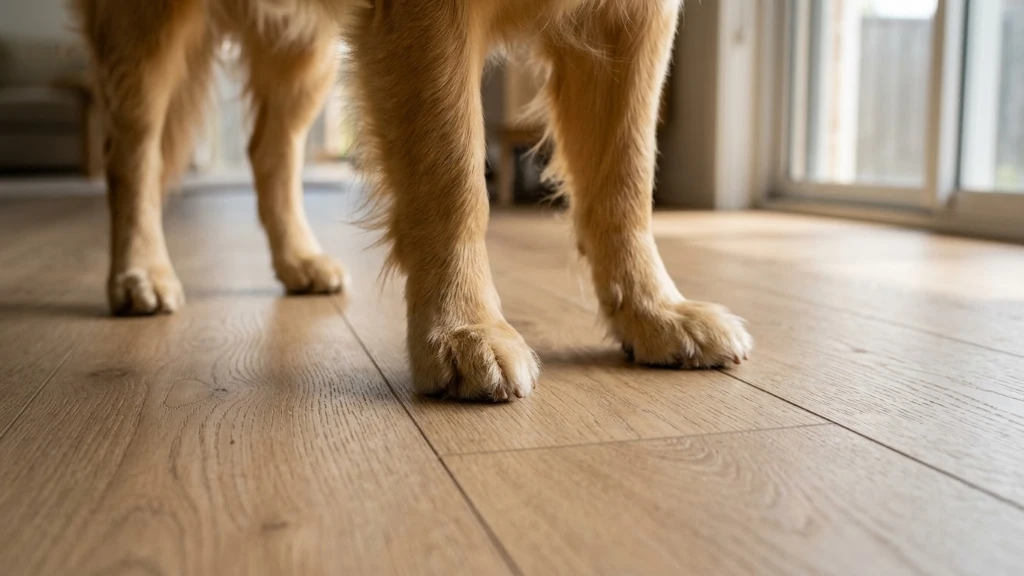
Hybrid and laminate resist scratches better than engineered timber. But when they do get damaged (and over fifteen years something will drag across them), they cannot be sanded back. A single board may be replaceable depending on the installation method, the locking system and where the damage sits, but the floor itself can’t be refinished.
Engineered timber is the opposite. It marks more easily, and it’s the only one of the three you can sand and refinish, typically once to three times depending on the wear-layer thickness. A dog that ruins an engineered floor in year six costs you a re-sand. The same dog on a hybrid floor costs you a floor.
So the real question isn’t which floor resists claws best on day one. It’s whether you’d rather buy damage resistance or damage repairability. Families with young kids usually want resistance. A household staying put for twenty years is often better off with timber they can reset.
One thing applies to all three: finish does more than material for how damage looks. Dark, high-gloss boards show every scratch and paw print; a mid-tone matt or textured board hides both. If two floors are level on durability, choose on finish. You’ll notice it every day, and the scratch resistance twice a decade.
Spills, Accidents and What’s Underneath
Hybrid’s rigid core is highly water-resistant, and on most products the core itself is waterproof, subject to product and warranty conditions. That’s useful with a toddler and a water bowl. But the plank is not the floor: joins, edges and the subfloor still matter, which is why we put it the way we do: the planks are waterproof, the floor as a system is highly water-resistant. We’ve covered where that line actually sits in detail.
Laminate is different. Modern ranges are rated for 48 to 72 hours of surface spill resistance, which covers a knocked drink you mop up that evening. It does not cover a puppy that isn’t house-trained, because the core is high-density fibreboard and water sitting in an unsealed join will eventually swell it.
With carpet and pets, the thing nobody mentions until it’s too late: the odour problem usually isn’t in the carpet. Accidents soak through the pile into the underlay and sometimes the subfloor. Reusing the old underlay to save $8–25/m² is the most common false economy here. The new carpet smells fine for a fortnight, then doesn’t. If there’s been a history of accidents, the underlay goes with the carpet.
Where Carpet Still Wins
Hard flooring everywhere is a fashion, not an upgrade. Bedrooms are warmer, quieter and safer with carpet on them, and in a house with kids that counts for more.
Solution-dyed nylon is the fibre to ask for. The colour is locked into the fibre rather than applied to the surface, so it resists fading and survives cleaning that would strip a dyed carpet. It lasts 12 to 15 years and sits at $35–70/m² supplied and installed, the same band as budget polyester, with roughly double the lifespan. The fibre detail is on our synthetic carpet range, and the full comparison in our carpet buying guide for Sydney homes. A dedicated guide to carpet for pets and families is coming soon on this blog.
Wool is warmer still, at $60–250/m² with most jobs at $90–150, but it stains more readily than solution-dyed nylon, which is worth knowing before it goes in a puppy’s room.
One more argument for carpet has nothing to do with the humans. Dogs slip on hard floors, and an older or heavier dog with hip trouble slips a lot. If your dog is ageing, put runners on the routes it actually walks: bed to door, door to water bowl. It’s the kindest thing you can do for an old dog in a renovated house.
What It Costs to Do It Properly
Supplied and installed in Sydney, including standard underlay and trims. Subfloor prep and old-floor removal are extra.
| Product | Full range | Most jobs land at | Lifespan |
|---|---|---|---|
| Solution-dyed nylon carpet | $35–70/m² | $40–70/m² | 12–15 years |
| Laminate | $50–100/m² | $60–80/m² | 15–25 years |
| Hybrid | $55–110/m² | $65–85/m² | 15–25 years |
| Engineered timber | $100–250/m² | $140–180/m² | 30–40 years, re-sandable |
The gap between laminate and hybrid at the mid tier is about $5/m²: $60–80 against $65–85. With kids and pets that’s the easiest $5 you’ll ever spend, because it buys a highly water-resistant floor in exactly the rooms where things get spilled. Hence the shortest rule we have: if the room has a tap, a drain or a washing machine, go hybrid. Full pricing by product and room size is in our Sydney flooring and carpet cost guide.
Five Things That Actually Make a Difference
- Mats at every external door, and one under the pet bowls. Grit tracked in from a Sydney backyard does more damage to a wear layer than claws do.
- Keep the dog’s nails trimmed. Unglamorous, and it matters more than the product you choose.
- Never use a steam mop. It forces vapour into the joins and voids most hybrid and laminate warranties. A well-wrung damp mop and a pH-neutral cleaner is all these floors need.
- Felt pads under every chair leg. Dining chairs mark family floors more than pets do.
- Don’t match the floor to the walls or cabinetry. Aim for two to three shades of contrast. It hides marks, and it’s the mistake we see most often in finished renovations.
Frequently Asked Questions
What flooring is best with kids and pets?
Hybrid through the wet and high-traffic zones, solution-dyed nylon carpet in the bedrooms. Hybrid gives you a waterproof core, subject to product and warranty conditions, and a wear layer you can specify for a busy house; nylon gives warmth, quiet and grip where people sleep. One product through the whole house means compromising in half of it.
Do dog claws scratch hybrid flooring?
They can mark it. Hybrid and laminate both handle claws better than engineered timber, and with hybrid the spec that decides it is the wear layer: 0.3 mm is too thin for a dog in a busy house, 0.5 mm is the sensible residential minimum, 0.7 mm is what we’d lay in a hallway a large dog uses daily. Trimmed nails and a doormat do more than an extra 0.2 mm ever will.
Can a scratched floor be repaired?
Engineered timber can be sanded back and refinished, typically once to three times depending on the wear-layer thickness. Hybrid and laminate can’t. A single board may be replaceable, but that depends on how the floor was installed, the locking system and where the damage sits.
Is carpet a bad idea if you have pets?
No, but the fibre and the underlay decide how it goes. Solution-dyed nylon resists fading and stands up to the cleaning pet ownership requires. The bigger issue is underneath: accidents soak into the underlay, so if there’s a history of them, replace the underlay with the carpet.
What flooring is best for a dog that slips?
Carpet, or hard flooring with runners along the routes the dog actually walks. A matt or textured finish grips marginally better than high gloss, but no hard floor gives an ageing dog the traction carpet does.
Is vinyl a good option for families with pets?
Payless supplies vinyl planks as a commercial product rather than a residential one, so for a home we’d point you to hybrid: same job, rigid core, heavier wear layer. If you’re specifying for a childcare centre, a vet clinic or a fitout, our commercial flooring page is the place to start.
Get a Real Number for Your House
Zoning a house properly is easier to price than to describe. Our measure is free, we bring samples so you see them under your own lighting, and the quote itemises subfloor preparation and removal instead of burying them. Our own installers do the work (not subcontractors), and every installation carries a one-year warranty.
Book a free measure and quote, or bring the kids and walk on the ranges at Belrose (Belrose Shopping Centre, Shop 1.10, 02 9486 3502) or Castle Hill (Hills Super Centre, Shop 85B, 16 Victoria Ave South Building, 02 8606 4840).