
“So — roughly what are we looking at?” It’s the first question in almost every measure we do, and it’s the one most flooring websites answer with a shrug and a “it depends.” It does depend — but that’s not an excuse to hide the numbers. So here they are, upfront: in Sydney in 2026, laminate typically runs $50–100/m² and hybrid $55–110/m² supplied and installed, engineered timber $100–250/m², and wall-to-wall carpet anywhere from $35 to $250/m² depending on fibre and range. A typical three-bedroom home lands somewhere between $3,500 (nylon carpet) and $18,000 (engineered timber throughout) — with most of our jobs landing well inside those extremes.
The rest of this guide earns those numbers: what each product really costs, the line items that never make the headline price, what whole homes actually come to, and how to compare quotes without being tricked by the cheapest one. It’s the conversation we normally have plank-by-plank in the showroom — written down.
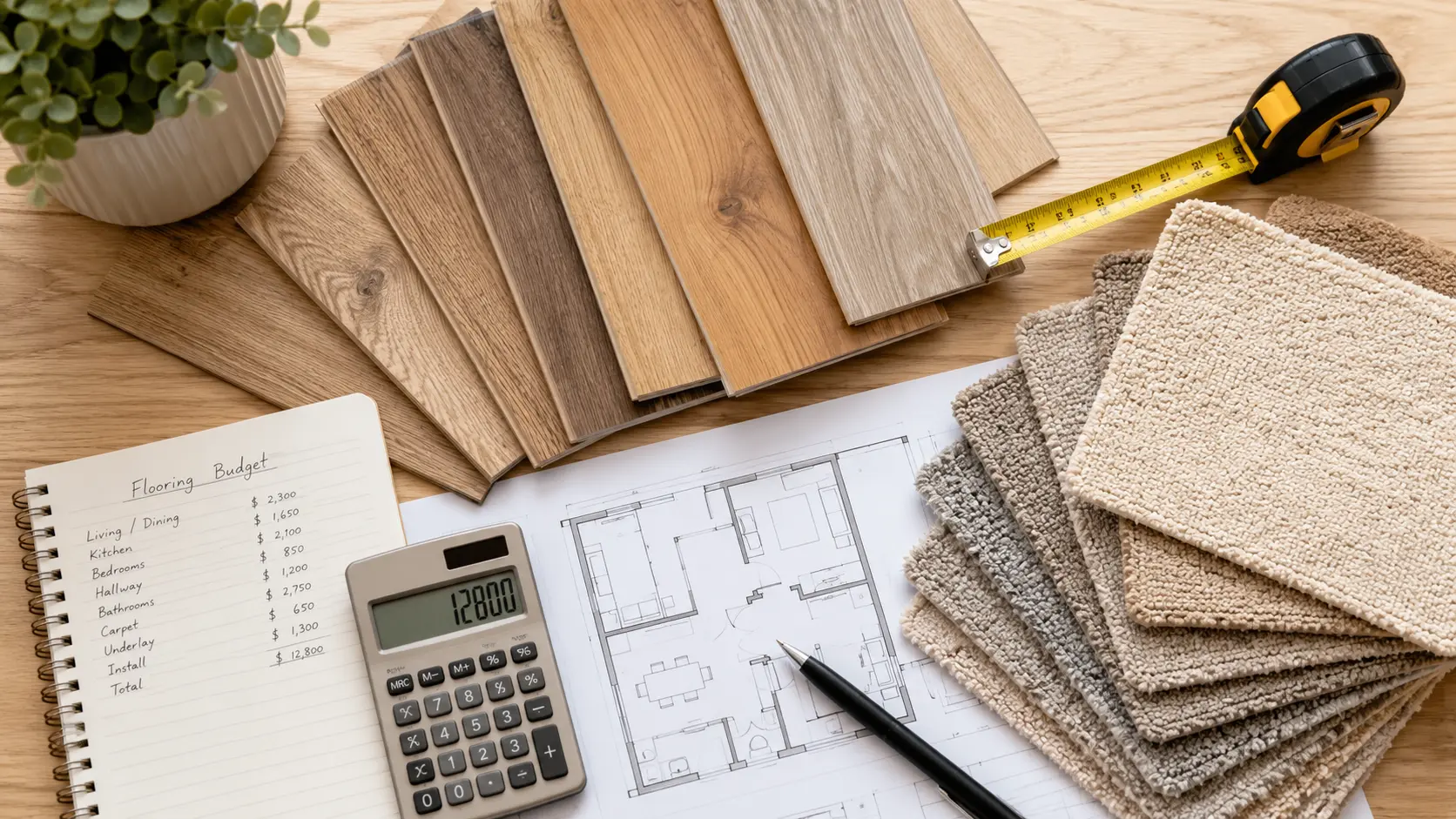
Sydney Flooring & Carpet Prices at a Glance (2026)
| Product | Supplied & installed | Most jobs land at | Worth knowing |
| Hybrid | $55–110 /m² | $65–85 /m² | Waterproof core; the whole-home favourite |
| Laminate | $50–100 /m² all-in | $60–80 /m² (entry from ~$50) | Cheapest timber look; underlay is mandatory |
| Engineered timber | $100–250 /m² | $140–180 /m² | Real timber; can be re-sanded |
| Carpet — synthetic | $40–110 /m² | $65–100 /m² | Solution-dyed nylon is the sweet spot |
| Carpet — wool | $60–250 /m² | $90–150 /m² | Premium feel, natural insulation |
Ranges are supplied-and-installed including standard underlay and trims, cross-checked against multiple 2026 Australian cost guides and weighted for Sydney — and aligned with the pricing already live on our hybrid vs laminate comparison. Subfloor preparation and old-floor removal are extra — covered below, because that’s where quotes really diverge.
Why Sydney Prices Run Higher Than the National Average
Sydney metro installation labour runs roughly 15–20% above regional NSW and the smaller capitals. Add three local multipliers: slab-on-ground construction across the Hills District and newer suburbs (levelling is needed more often), strata acoustic-underlay requirements in apartment-heavy areas, and access — a fourth-floor walk-up in the inner city takes longer than a driveway in Kellyville. The one lever that works in your favour: job size. Most installers, us included, discount the per-metre rate on jobs over about 80 m² — whole-home projects buy better than room-by-room.
Hybrid Flooring: $55–110/m² Installed
Hybrid splits into tiers, and the tier lives in the spec sheet, not the photo. Budget SPC boards sit toward the bottom of the range — typically thinner cores and a 0.3 mm wear layer, fine for a rental bedroom, undersized for a family kitchen. Quality residential ranges (like our Easi-Plank, at a 0.5 mm wear layer) sit in the middle, with premium wide-plank and thicker-core formats (like Aspire, at 0.7 mm) toward the top. Installation labour is typically $25–45/m² for a straightforward floating lay. Put together, most family jobs land at $65–85/m² all-in.
New to the category entirely? Start with our plain-English explainer, what is hybrid flooring? — and if you’re weighing it against laminate, our full hybrid vs laminate comparison settles it room by room. A dedicated hybrid cost deep-dive is coming soon on this blog. Browse the hybrid flooring range for current colours.
Laminate: The Cheapest Timber Look — With One Non-Negotiable
Laminate boards themselves vary with thickness, AC wear rating and water resistance, with labour typically at $25–45/m². All-in, entry builds start from around $50/m² and most jobs land at $60–80/m², with premium ranges approaching $100/m².
The non-negotiable: laminate must go over underlay, and the underlay is not the place to save. On a concrete slab, a 3 mm foam with an integrated moisture barrier ($6–10/m²) is the default — it protects the wood-fibre core from slab moisture. In apartments, acoustic rubber underlay ($10–18/m²) is often what gets your strata approval over the line. For the full breakdown — the three tiers, the underlay line and what a fair quote looks like — read our laminate flooring cost guide; the laminate flooring range shows what each tier looks like in the flesh.
Engineered Timber: $100–250/m²
Two things put engineered timber a step above the floating floors: the top layer is genuine hardwood, and laying real timber is a slower, more skilled trade. Engineered oak sits toward the lower-middle of the range, typically $100–150/m², while Australian hardwood species (Blackbutt, Spotted Gum) and premium formats like wide-plank, herringbone or chevron push toward $150–250/m², with pattern layouts adding a labour premium on top of the board cost. Most Sydney jobs land at $140–180/m² installed. The counterweight to the price: a quality engineered floor can be re-sanded when it tires, stretching its life across decades — on a cost-per-year basis, it’s more competitive than the upfront number suggests. See current species in the engineered timber flooring range
Carpet: The Per-Metre Price Is Only Half the Story
| Fibre | Installed range | The honest read |
| Budget synthetic (polyester/polypropylene) | $40–70 /m² | Cheapest option — flattens under heavy traffic; right for spare rooms and rentals |
| Solution-dyed nylon | $35–70 /m² | The modern default: durable, fade-resistant, bounces back from furniture |
| Wool | $60–250 /m² | Natural insulation and the best feel underfoot; premium and bespoke weaves sit at the top of this range |
Three carpet-specific things that decide your real total. First, underlay ($8–25/m²): a premium carpet on cheap underlay feels like walking on concrete, and cheap underlay shortens carpet life — high-density rubber at $15–20/m² is the right call for stairs and hallways. Second, the roll-width quirk: carpet comes on 3.66 m rolls, so you’re billed on the carpet that has to be cut, not just your visible floor area — a 4.0 × 3.0 m room (12 m²) uses about 14.6 m² of carpet. Third, the quality signal: if a quote mentions power-stretching and AS/NZS installation standards, you’re dealing with professionals; if it doesn’t, ask why.
For a typical 100 m² of carpeted area, expect roughly $3,500–7,000 in solution-dyed nylon, and $9,000–15,000 in wool — straight multiplication of the installed rates; volume pricing on whole-home jobs and entry-level stock often lands below these figures. Full carpet cost and carpet replacement cost guides are coming soon on this blog — meanwhile, the wall-to-wall carpet range covers our wool and synthetic collections.
The Costs That Never Make the Headline Number
None of these are padding — they’re the difference between a floor that lasts twenty years and one that clicks apart. But they are where two quotes for “the same floor” quietly diverge:
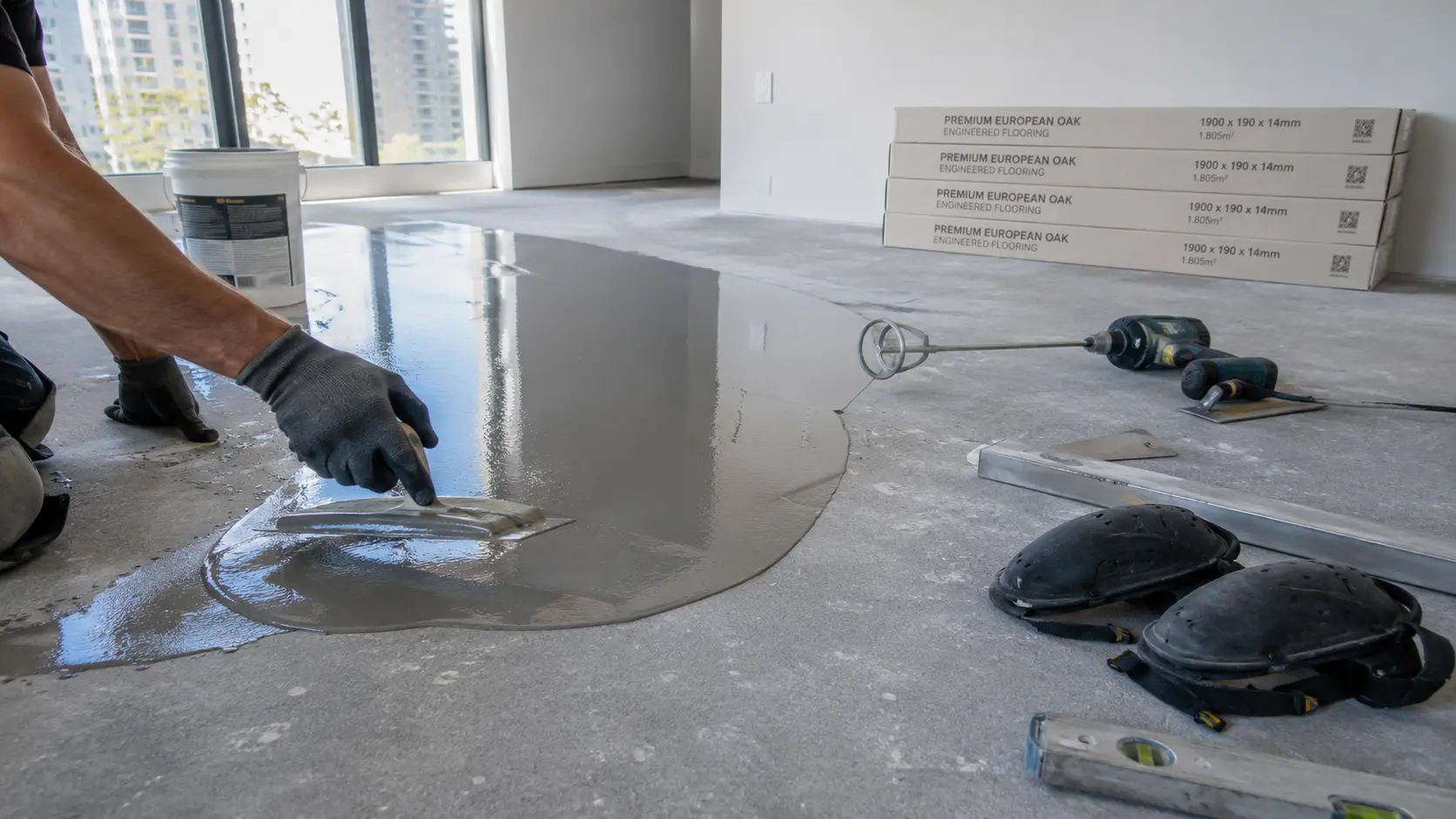
- Subfloor levelling: $25–45/m² where a slab is out of tolerance — the single biggest variable in hard-flooring quotes.
- Moisture testing: $150–300 flat fee — near-mandatory on any concrete slab less than 12 months old, before anyone will warrant the job.
- Moisture barrier or DPM: $25–50/m² if the slab tests damp.
- Old floor removal: $15–35/m² for carpet or laminate; tile or glued vinyl demolition: $40–80/m² — the most commonly under-budgeted line item in renovations.
- Scotia and trims: $5–15 per linear metre — the finishing detail that makes a floating floor look built-in.
- Furniture moving: $100–300 per job if we do it (or free if you do).
- Wastage: add 8–10% to material quantities for cuts — more for herringbone and rooms with many doorways.
- Stairs and rush jobs: stairs typically run $80–140 per step supply and labour combined; rush timelines (under two weeks) commonly carry a 10–15% premium.
A full installation-and-hidden-costs guide is coming soon; until then, the golden rule is simple: a quote without these lines itemised isn’t cheaper — it’s just incomplete.
What Flooring Costs Room by Room
Whole-home numbers are useful for budgeting; room numbers are what you’ll actually be quoted. Using the “most jobs land at” rates above:
| Room | Carpet (nylon) | Laminate | Hybrid |
| Standard bedroom (12 m²) | $420–840 | $720–960 | $780–1,020 |
| Living + dining (30 m²) | $1,050–2,100 | $1,800–2,400 | $1,950–2,550 |
| Kitchen (15 m²) | — (not recommended) | — (not recommended) | $975–1,275 |
These figures are calculated on floor area. For carpet, the extra material that roll width forces you to buy is already allowed for in the installed rate — which is why carpet is quoted per square metre of room, not per square metre of roll.
One honest caveat: a single small room usually prices above these per-metre rates, because call-out, setup and trims don’t shrink with the room. It’s the flip side of the whole-home discount — and a good argument for bundling that spare bedroom into the bigger job.
For landlords and investors: durable mid-grade beats premium in a rental every time — budget-to-mid synthetic carpet in bedrooms, entry laminate or hybrid through living zones. Which product belongs in which room is exactly what our complete guide to choosing flooring for your Sydney home walks through.
What a Whole Home Actually Costs
| Scenario (typical 3-bed, ~100 m²) | Realistic 2026 range |
| Carpet throughout — solution-dyed nylon | $3,500 – $7,000 |
| Carpet throughout — wool | $9,000 – $15,000 |
| Laminate throughout | $6,000 – $8,000 |
| Hybrid throughout | $6,500 – $8,500 |
| Engineered timber throughout | $14,000 – $18,000 |
Ranges assume a reasonably sound subfloor and the “most jobs” rate for each product; premium selections push toward the top of the full per-m² range (up to $110 hybrid, $100 laminate, $250 engineered, $250 carpet), and levelling or tile demolition sits on top. And note the strategy most of our customers actually land on: mixing — hybrid through the kitchen, laundry, entry and living zones, carpet in the bedrooms. It’s warmer where you want warmth, waterproof where you need it, and it usually beats any single-product budget.
Think in Cost per Year, Not Just Cost per Metre
The per-metre price tells you what a floor costs to buy. Dividing it by an honest lifespan tells you what it costs to own — and it quietly reorders the rankings:
| Product | Typical installed price | Realistic lifespan | ≈ Cost per m² per year |
| Budget synthetic carpet | $40–70 /m² | 5–10 years | $4–14 |
| Solution-dyed nylon carpet | $35–70 /m² | 12–15 years | $2.33–5.83 |
| Wool carpet | $90–150 /m² | 15–25 years | $3.60–10 |
| Laminate | $60–80 /m² | 15–25 years | $2.40–5.30 |
| Hybrid | $65–85 /m² | 15–25 years | $2.60–5.70 |
| Engineered timber (re-sanded once) | $140–180 /m² | 30–40 years | $3.50–6 |
(Method: low price ÷ longest lifespan gives the low end; high price ÷ shortest lifespan gives the high end, using the “most jobs land at” price band for each product. Lifespans are estimates, so read these as comparative bands, not precise figures.) Two things jump out. Budget synthetic carpet is often the most expensive floor in the table once its shorter life is priced in. And engineered timber — the biggest upfront number — becomes genuinely competitive per year of ownership, because a re-sand resets it instead of replacing it. Neither means budget options are wrong; it means the right question is “cheapest for how long?”
When You Buy Matters (a Little)
Flooring has quiet seasons and loud ones. Suppliers run their biggest promotions around EOFY and in the late-summer window, and if your dates are flexible, asking “what’s on promotion right now?” can genuinely move the number — published guides put typical promotional savings at 10–18% on materials. The reverse is also true: rush jobs booked under two weeks out commonly carry a 10–15% premium. Flexibility is a discount you already own.
How to Compare Quotes Apples to Apples
- Insist on itemised lines: supply, underlay, labour, prep, trims, removal and disposal — each visible.
- Match the spec, not the product name: the same “hybrid” label can hide a 0.3 mm or a 0.7 mm wear layer, an AC3 or AC5 laminate.
- Ask who owns the workmanship: product warranties come from manufacturers — installation warranties come from the installer. Ours is 1 year on every install.
- Treat the suspiciously cheap quote as a puzzle: the missing money is almost always in prep or trims, and it finds you after the furniture’s back in.
We’ll publish a full breakdown of what a free measure and quote includes soon — the short version is: everything above, measured instead of guessed.
FAQs
How much does it cost to floor a whole 3-bedroom house in Sydney?
For around 100 m²: roughly $3,500–7,000 in nylon carpet, $6,000–8,000 in laminate, $6,500–8,500 in hybrid, and $14,000–18,000 in engineered timber — before any subfloor prep or tile removal.
Is carpet cheaper than hybrid flooring?
Budget synthetic carpet ($40–70/m²) is clearly the cheapest option upfront. But mid-range solution-dyed nylon and hybrid now sit close together in price ($65–100 vs $65–85/m²) — so the real question is usually waterproofing and durability, not cost. Most whole-home budgets do well mixing both: carpet for warmth in bedrooms, hybrid for durability in working zones.
Does installation include removing my old floor?
Usually it’s a separate, itemised line — and the gap is real: lifting old carpet or laminate runs $15–35/m², demolishing tiles or glued vinyl runs $40–80/m². Always check which one your quote assumes.
Why did I get three very different quotes for the same room?
Almost always: different product specs wearing the same name, different assumptions about subfloor prep, or different things quietly excluded. Line up the itemised rows side by side and the mystery usually solves itself.
What’s the cheapest way to get a timber look?
Entry-level laminate, from around $50–60/m² installed — provided the room stays dry. The moment a room has a tap, a drain or a washing machine, hybrid’s modest premium over laminate is the cheaper decision long-term.
The Only Number That Matters Is Yours
Ranges get you budgeting; a measure gets you a number — including the subfloor story no website can see. Book a free measure and quote — no obligation — or bring your floor plan into the Belrose or Castle Hill showroom and we’ll price it on the spot.