
Walk into almost any flooring showroom in Sydney — ours included — and hybrid is one of the categories you’ll see most often. It has become one of the most frequently requested flooring types for Sydney homes. And yet, when we ask people what they think hybrid actually is, the honest answer is usually some version of: “…good?”
So here’s the plain-English version. Hybrid flooring is rigid-core plank flooring that combines the easy click-together installation and realistic timber look associated with laminate with a rigid core that is far less sensitive to water-related swelling. That combination has made it a popular choice across Australian homes over the past decade.
If you’re mid-research on the bigger decision, this explainer slots into our complete guide to choosing flooring for your Sydney home — but everything you need to understand hybrid itself is right here.
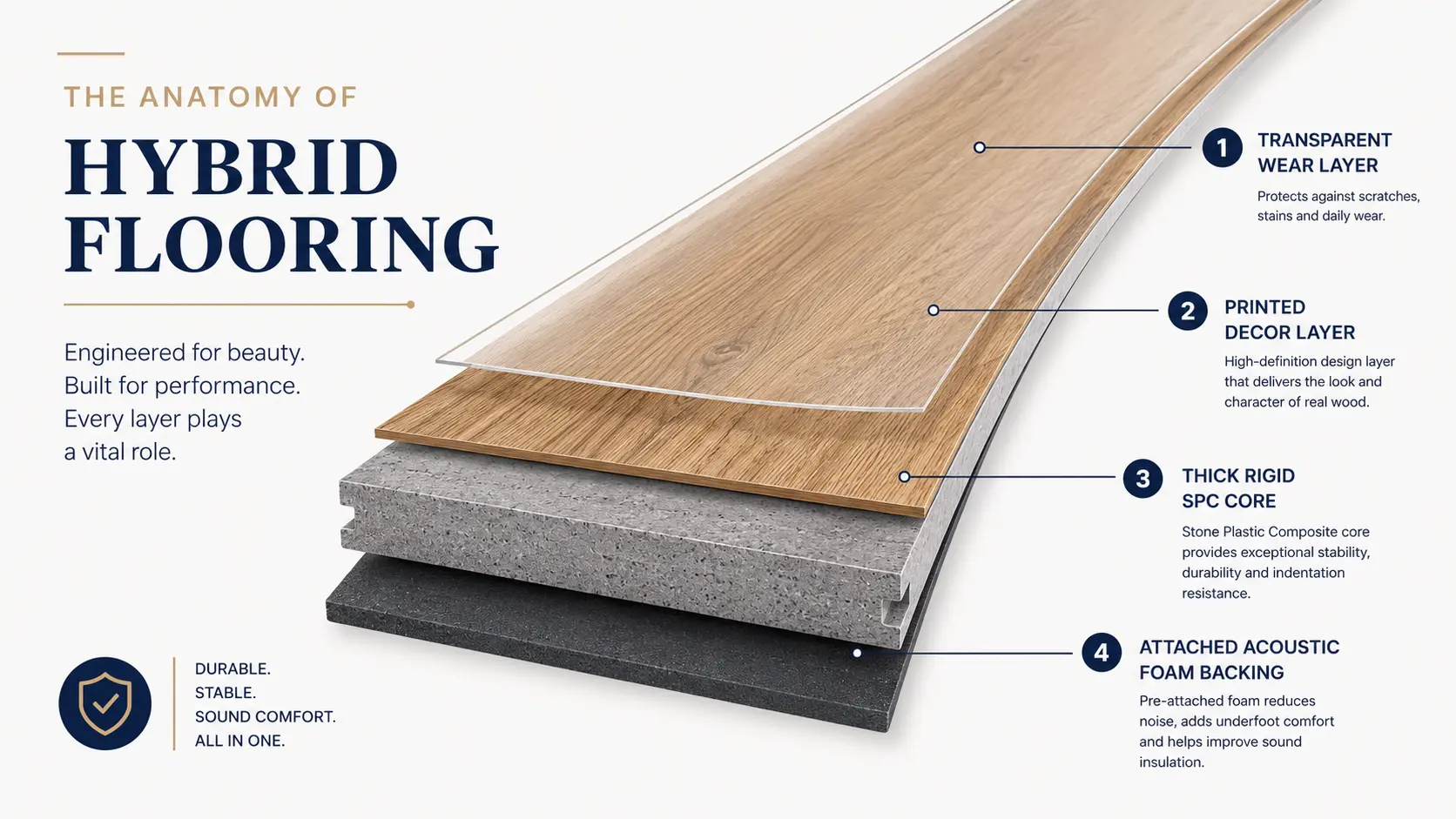
What’s Inside a Hybrid Plank: The Main Layers
Most hybrid flooring is built from several functional layers, although the exact construction varies between products and ranges:
- The wear layer. A transparent protective surface on top, commonly ranging from around 0.3 mm to 0.7 mm depending on the product. Wear-layer thickness is an important durability specification, but overall performance also depends on the core, locking system, installation and maintenance.
- The decor layer. A high-definition print of timber grain or stone. This is why hybrid can convincingly recreate looks such as European Oak, Blackbutt or Spotted Gum at a lower price than genuine hardwood.
- The rigid core. The structural centre of the plank — commonly SPC, WPC or another rigid composite construction. Unlike laminate’s wood-fibre HDF core, a hybrid core is generally much less susceptible to moisture-related swelling.
- The acoustic backing. Many hybrid ranges include an attached foam or acoustic layer, which can improve walking comfort and reduce sound transmission. For apartment projects, the complete flooring and underlay system still needs to meet the building’s acoustic requirements.
A click-lock profile is usually formed along the plank edges, allowing the boards to connect and float over a properly prepared subfloor. The subfloor must still be flat, dry and structurally sound, and the installation method must follow the requirements of the specific product.
SPC vs WPC (and RCB): The Types, Decoded
SPC — stone polymer composite. A dense rigid-core construction known for dimensional stability and a firm feel underfoot. Our Easi-Plank range uses SPC construction.
WPC — wood plastic composite. A slightly softer and warmer rigid-core construction that can feel quieter underfoot. Our Iconic range uses WPC construction.
RCB — rigid composite board. Another form of rigid-core construction designed to balance stability, comfort and performance. Our Aspire range uses RCB construction.
None of the three is automatically “better” for every home — they are built differently and can feel different underfoot. The most practical way to compare them is to see and walk on the products side by side.
You can browse all three in the hybrid flooring range or compare them in person at our Belrose or Castle Hill showroom.
Why Sydney Took to Hybrid So Fast
- Coastal and changing humidity. Rigid-core hybrid flooring is generally more dimensionally stable than natural timber through normal indoor temperature and humidity changes.
- Concrete slabs. Many Sydney homes sit on concrete slabs. Hybrid can often be installed as a floating floor over a properly prepared slab, subject to flatness, moisture testing and the manufacturer’s installation requirements.
- Apartments and strata. An attached acoustic backing can help with sound control, but approval depends on the complete tested flooring system and the specific requirements of the strata scheme.
The Honest Pros and Cons
Where hybrid earns its popularity:
- Highly water-resistant rigid core — a strong option for kitchens, entries and everyday spill-prone areas. Suitability for laundries, bathrooms and other wet areas depends on the specific product warranty and installation requirements.
- Good scratch and impact resistance — performance varies by product, wear layer, core construction and maintenance.
- Can often be installed over existing surfaces, including sound and level tiles, when permitted by the manufacturer — potentially reducing demolition and disruption.
- Good dimensional stability through normal indoor temperature and humidity changes.
- Low maintenance — regular sweeping or vacuuming and cleaning with a well-wrung damp mop is usually sufficient. Always follow the product’s care instructions.
Where it isn’t magic:
- It can’t normally be sanded back or refinished. A damaged board may be replaceable, depending on the installation method, locking system and location of the damage.
- Quality varies significantly. Plank thickness, wear-layer specification, core density, locking system, acoustic backing and warranty can differ between products that look almost identical in a photograph. Check the specification, not only the price.
- A water-resistant plank does not create a floodproof flooring system. Water can still migrate through joins and around the perimeter to the underlay or subfloor. We’ve unpacked exactly where the line sits in is hybrid flooring really waterproof?
What Does Hybrid Flooring Cost?
For a straightforward Sydney installation in 2026, quality hybrid flooring commonly falls around AUD $55–110 per square metre supplied and installed. Premium ranges, complex layouts, floor removal, subfloor levelling, trims and other preparation work can increase the final cost. For a product-specific breakdown of the price tiers, wear layer and installation costs, see our hybrid flooring cost guide.
Plank construction, wear layer, job size and subfloor condition all influence the final quote. We’ve broken down hybrid, laminate, engineered timber and carpet pricing in our complete flooring and carpet cost guide.
Is Hybrid Right for You?
It’s probably worth considering if you have kids or pets; kitchens, entries or other spill-prone areas are in scope; you live near the coast; you are flooring a rental or investment property; or you want one continuous timber-look floor through several living areas.
For laundries, bathrooms and other wet areas, suitability must be confirmed against the warranty and installation requirements of the specific product.
Look elsewhere if you want genuine timber that develops natural character and may be re-sanded — that is engineered timber’s territory — or if you are flooring quiet, dry bedrooms on a tighter budget, where laminate can save meaningful money.
We’ve compared the two options head-to-head in hybrid vs laminate flooring: which is best for your home?
FAQs
Is hybrid flooring the same as vinyl plank?
They are related, but they are not exactly the same. Many traditional vinyl planks are flexible and may be installed using adhesive, while hybrid flooring has a rigid core and is commonly installed as a click-together floating floor.
Hybrid still requires a flat, dry and properly prepared subfloor; it should not be treated as a solution for subfloor imperfections.
We also range traditional vinyl products for selected commercial applications — see our commercial flooring page if that is your use case.
How long does hybrid flooring last?
With proper installation and care, quality hybrid flooring can provide around 15–25 years of service. Actual lifespan depends on the product specification, wear layer, traffic level, room conditions, installation quality and maintenance.
The wear layer is an important specification, but it should be considered alongside the core construction, locking system and warranty rather than used as the only measure of quality.
Why do hybrid prices vary so much between ranges?
Core construction, wear-layer thickness, plank dimensions, locking system, acoustic backing, surface finish and warranty can all affect the price.
Two planks that look almost identical in a photo can be manufactured to very different specifications — which is why we would rather show you the specification sheet than only the sale price.
Can I install hybrid flooring myself?
The click-lock system can appear DIY-friendly, but the finished result is often decided by less visible details: subfloor flatness, moisture testing, expansion gaps, transitions, trims and correct product acclimatisation where required.
Our installations are completed by our installation team and include a 1-year installation warranty. For many homeowners, professional installation is the more practical option once preparation, tools, time and warranty conditions are considered.
See (and Feel) the Difference
Specifications explain hybrid; standing on it helps you understand the differences between products.
Visit our Belrose or Castle Hill showroom to compare SPC, WPC and RCB ranges side by side — or book a free measure and quote and we’ll bring suitable samples to your home.