
Straight to it: in Sydney in 2026, laminate flooring costs $50–100 per square metre supplied and installed, and most jobs land at $60–80/m². For a typical three-bedroom home that’s roughly $6,000–8,000 for the whole floor — which makes laminate the most affordable way into a convincing timber look.
The catch is that laminate is also the flooring category where quotes vary most wildly for what looks like the same product. Two boards can sit side by side in a showroom, look identical, and differ by $30/m² — because the things that set the price are all invisible: the core thickness, the wear rating, the click system, and whether the quote included underlay at all. This guide makes those invisible things visible, so you can tell a genuinely good price from a merely low one.
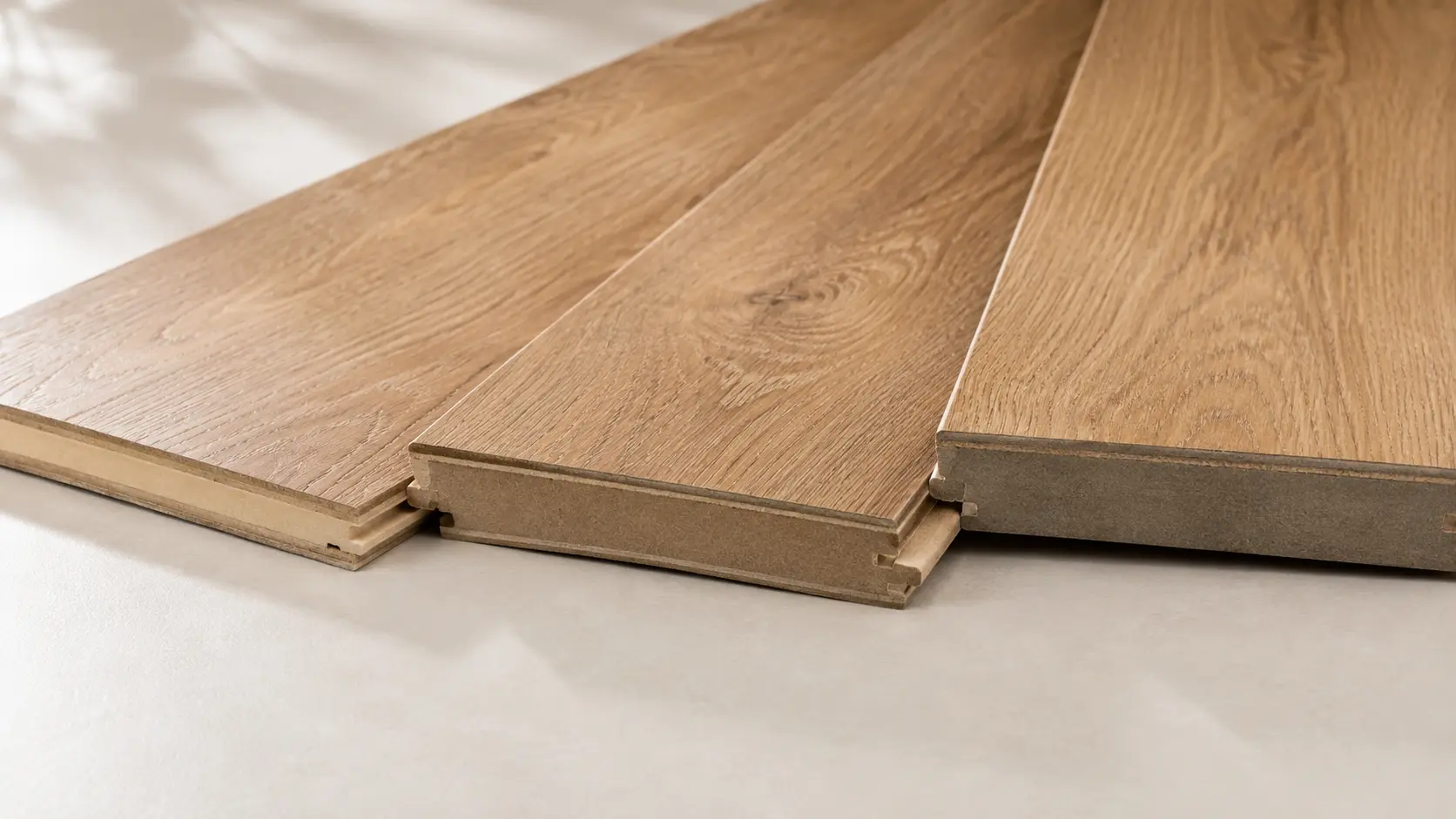
Laminate Price Breakdown: Where Your Money Goes
A laminate quote is four numbers stacked together — and one of them is the line people forget to check:
| Component | Typical Sydney range | What moves it |
| Laminate boards (supply only) | $20–60 /m² | Core thickness (8/10/12 mm), AC wear rating, water resistance, click system |
| Installation labour | $25–45 /m² | Straight floating lay in a simple room sits low; multi-room and hallway jobs sit high |
| Underlay | $6–18 /m² | Mandatory — moisture-barrier foam at the low end, acoustic rubber for strata at the high end |
| Scotia / trims | $5–15 per lm | Perimeter finishing — priced per linear metre, not per m² |
| Total (all-in) | $50–100 /m² | Most jobs: $60–80/m² · entry builds from ~$50 |
Those extremes rarely combine. An entry job near $50/m² pairs a thin board with basic foam underlay and a simple straight lay; a job near $100/m² is a 12 mm water-resistant board with acoustic underlay across a multi-room layout. Sydney metro labour sits at the top of the national band, which is why our range starts a little higher than guides written for regional Australia.
The Three Laminate Tiers, and Who Each One Is For
Laminate is priced almost entirely on three specs: core thickness, AC wear rating, and water resistance. Here’s how they stack into real tiers:
Entry tier — around $50–60/m² installed
Thinner 8 mm cores, usually AC3 rated (the residential-grade wear rating), with limited or no water-resistance claim. This is honest value for a spare bedroom, a home office, or a rental where the floor needs to look good and handle normal foot traffic. It’s the wrong pick for a hallway that takes the whole family every day, and the wrong pick anywhere near water.
Mid tier — around $60–80/m² installed (where most jobs land)
Thicker cores with an AC4 rating — heavy residential — plus a water-resistant core rated to survive spills for a set window before damage occurs. Our Oakleaf and Oakleaf HD Plus collections sit here, with European Oak and Australian timber visuals, AC4 surfaces and a 48-hour water-resistant core. For most Sydney homes doing bedrooms, living areas and hallways, this is the band that makes sense.
Premium tier — around $80–100/m² installed
12 mm cores, AC5 wear ratings, extended moisture protection and better click systems. Our Aquastop range — engineered by the Swiss Krono Group — sits at this level with up to 72-hour moisture protection depending on thickness. You’re buying quieter, more solid-feeling underfoot performance and a floor that tolerates a busier household. See how each tier looks in person in the laminate flooring range.
One spec that rarely makes the sales tag but changes the install: the click system. Older 2G click boards are slower to lay and more prone to joint failures over time; newer drop-lock systems go down faster and hold better. If two quotes differ and the boards look the same, this is one of the places to look.
The Underlay Line You Can’t Skip
This is the single biggest difference between a laminate quote and a hybrid quote. Most quality hybrid planks arrive with acoustic backing already bonded on. Laminate never does — it must be laid over separate underlay, and that line belongs on your quote:
- 3 mm foam with integrated moisture barrier: $6–10/m² — the default on any concrete slab. It protects laminate’s wood-fibre HDF core from slab moisture, which is the most common cause of premature laminate failure in Sydney homes.
- Acoustic rubber underlay: $10–18/m² — what usually gets a hard floor approved in an apartment. Most Sydney strata schemes set an acoustic requirement for hard flooring, and this is the line that satisfies it.
If a laminate quote doesn’t show an underlay line at all, that isn’t a saving — it’s either buried in the rate or genuinely missing, and the second one costs you a floor. For the full head-to-head on where laminate and hybrid each make sense, read hybrid vs laminate flooring.
What Your Home Will Actually Cost
Using the mid-tier rate most jobs land at ($60–80/m²):
| Space | Area | Estimated installed cost |
| Home office / small bedroom | 10 m² | $600 – $800 |
| Standard bedroom | 12 m² | $720 – $960 |
| Living + dining | 30 m² | $1,800 – $2,400 |
| Apartment (2-bed) | 70 m² | $4,200 – $5,600 |
| Whole home (3-bed) | 100 m² | $6,000 – $8,000 |
| Large home | 150 m² | $9,000 – $12,000 |
Job size moves the rate. Most installers, us included, discount the per-metre rate on jobs over about 80 m² — so a whole-home laminate project usually beats the room-by-room maths. The reverse is true for one small room on its own: call-out, setup and trims don’t shrink with the floor area, so a single 10 m² study typically prices above the per-metre rate.
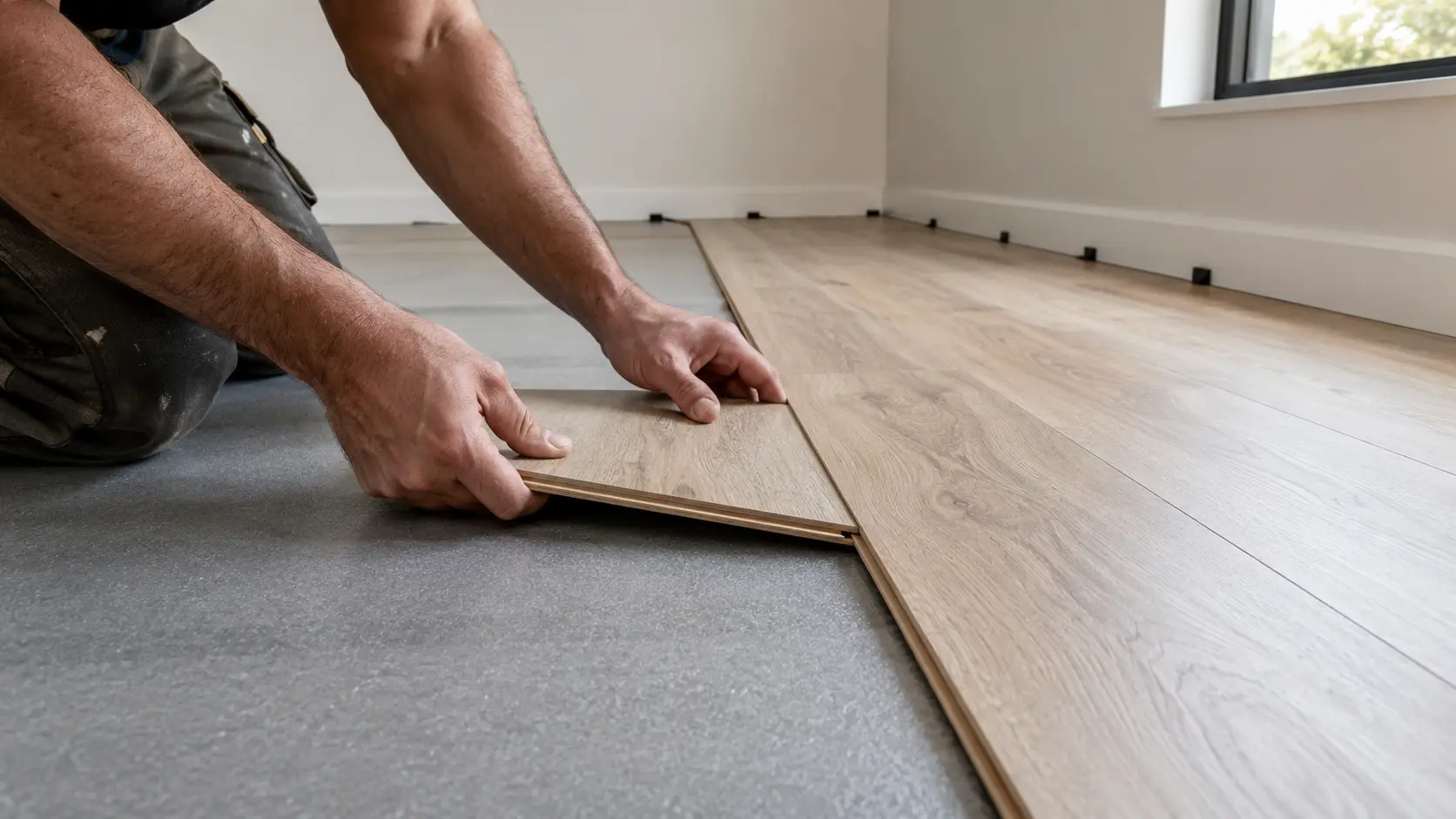
The Costs That Aren’t in the Headline Price
Laminate is less forgiving of a bad subfloor than hybrid is, which makes prep the line to watch most closely here:
- Subfloor levelling: $25–45/m² where a slab is out of tolerance. Laminate click joints fail early over high spots — roughly anything more than 3 mm across a 2-metre span — so this isn’t an upsell, it’s what keeps the joints together.
- Moisture testing: $150–300 flat fee — near-mandatory on a concrete slab under 12 months old before any warranty will stand. Laminate’s HDF core makes this more important than it is for hybrid.
- Old floor removal: $15–35/m² for carpet; tile or glued vinyl demolition: $40–80/m² — the most commonly under-budgeted line in a renovation.
- Pattern layouts: add 30–50% to labour for herringbone or diagonal lays — far more cuts, far more waste.
- Wastage: add 8–10% to board quantities for cuts — more in homes with many doorways or angled walls.
- Stairs: $80–140 per step supply and labour combined, priced separately from the floor area.
- Furniture moving: $100–300 per job if we handle it (free if you clear the rooms yourself).
Because laminate floats, it can often go straight over existing sound, level tiles — which skips demolition entirely and can take $40–80/m² out of the job. Whether your floor qualifies is a condition-and-levels question, which is exactly what we check at the measure. Every hidden cost that applies across all flooring types is covered in our complete flooring & carpet cost guide.
Is the Cheapest Laminate Actually the Cheapest Floor?
Upfront, laminate wins on price. Over the life of the floor the ranking holds — but only if the board is right for the room:
| Product | Most jobs land at | Realistic lifespan | ≈ Cost per m² per year |
| Laminate | $60–80 /m² | 15–25 years | $2.40 – $5.30 |
| Hybrid | $65–85 /m² | 15–25 years | $2.60 – $5.70 |
| Engineered timber | $140–180 /m² | 30–40 years | $3.50 – $6.00 |
| Solution-dyed nylon carpet | $35–70 /m² | 12–15 years | $4.30 – $9.20 |
(Method: low price ÷ longest lifespan gives the low end; high price ÷ shortest lifespan gives the high end. Lifespans are estimates — read these as comparative bands, not precise figures.) Laminate is genuinely the lowest cost-per-year floor in the table — in the rooms it belongs in. Put an entry-tier laminate in a kitchen or laundry and that maths inverts fast, because a swollen board can’t be repaired, only replaced. The honest rule we give in the showroom: if the room has a tap, a drain or a washing machine, spend the extra $10–20/m² on hybrid. Everywhere else, laminate is the smart spend.
How to Read a Laminate Quote
Four questions turn a confusing set of numbers into a fair comparison:
- What’s the AC rating and core thickness? AC3 8 mm and AC5 12 mm are both “laminate” and can differ by $30/m². This single line explains most price gaps between quotes.
- Is underlay a visible line item? It’s mandatory. If you can’t see it on the quote, ask which underlay and what it costs — the answer tells you a lot about the rest of the quote.
- What water-resistance rating does the board carry? “Water-resistant” is a spec with a number of hours attached, not a marketing word. Ask for the figure.
- Is subfloor prep included or excluded? A quote that assumes a perfect slab isn’t cheaper — it’s incomplete, and with laminate the consequences show up in the joints within a couple of years.
Worth knowing: product warranties come from the manufacturer, installation warranties come from the installer. Ours is 1 year on every install, on top of the manufacturer’s product cover.
FAQs
How much does laminate flooring cost per m² in Sydney?
$50–100/m² supplied and installed, with most jobs at $60–80/m². Boards are typically $20–60/m², installation labour $25–45/m², and underlay $6–18/m² on top.
How much to lay laminate in a 3-bedroom house?
For around 100 m², budget $6,000–8,000 at the mid-tier rate — before subfloor levelling or old-floor removal. Jobs over about 80 m² usually attract a better per-metre rate.
Is laminate cheaper than hybrid flooring?
Yes, but by less than most people expect — roughly $5/m² at the mid tier, $60–80 for laminate against $65–85 for hybrid. The laminate figure already includes the underlay that hybrid carries bonded to the plank, which is why the gap is so small. Our hybrid flooring cost guide sets out the hybrid side in full.
Do I really need underlay under laminate?
Always. It provides the moisture barrier that protects the HDF core, evens out minor subfloor variation, and cuts impact noise — which in an apartment is usually a strata requirement rather than a preference. Skipping it is the fastest way to void a warranty.
Does thicker laminate mean better laminate?
Partly. A 12 mm board feels more solid, sounds quieter and is more forgiving over an imperfect subfloor. But the AC wear rating on the surface determines how the floor looks in ten years — an 8 mm AC4 board in a bedroom will outlast a 12 mm AC3 board in a hallway.
Get the Real Number for Your Home
Ranges are for budgeting; a measure is for deciding — and with laminate, the subfloor check is the part no website can do for you. Book a free measure and quote — no obligation — or bring your floor plan into the Belrose or Castle Hill showroom and compare the tiers underfoot before you commit.