
Engineered timber flooring has become one of the most loved and practical flooring choices for Australian homes and it’s easy to see why. It delivers the beautiful warmth, unique grain patterns, and timeless character of real hardwood while offering much better stability and everyday performance in our often unpredictable climate.
From older homes in Sydney to new builds in Melbourne, coastal houses in Queensland, and modern apartments in Perth, engineered timber is widely used across different home styles. It can handle everyday family life, pets, and seasonal climate changes more reliably than many traditional timber options.
Unlike solid hardwood, which can expand, contract, develop gaps or even cup when humidity and temperature fluctuate, engineered timber is specifically engineered to stay far more stable. At the same time, it still gives you that genuine timber feel underfoot and the satisfying ability to sand and refinish it over the years. This combination makes it a smart middle-ground option for renovators, new home builders, and investors who want beautiful natural flooring without constant maintenance worries or costly surprises down the track.
In this guide, we’ll walk you through exactly what engineered timber flooring is, how it’s manufactured, its genuine benefits and potential drawbacks, how it compares with solid timber and hybrid flooring, and whether it’s the right choice for your home and lifestyle.
What Is Engineered Timber Flooring?
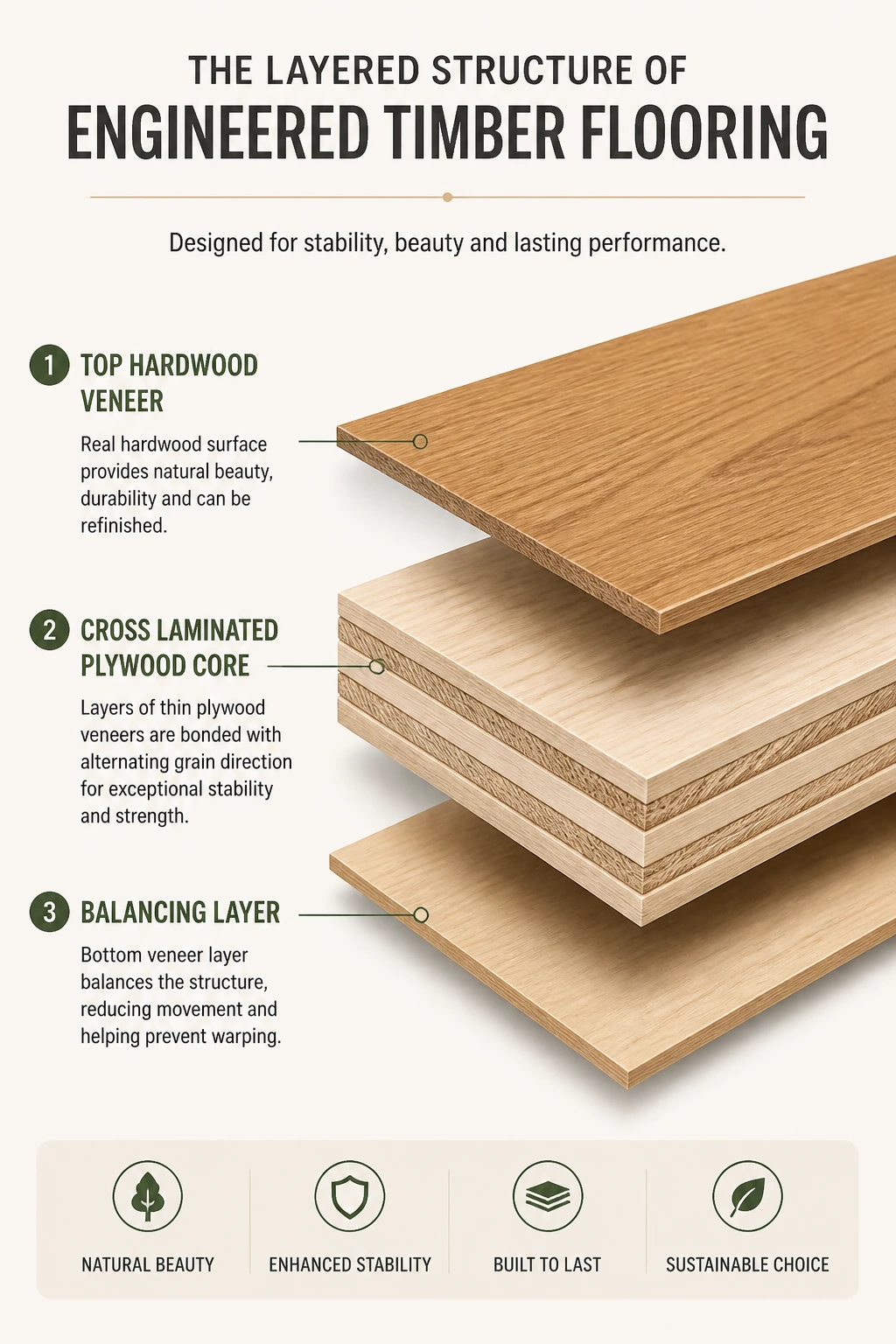
Engineered timber flooring is a multi-layer flooring system with a real hardwood surface bonded to a stable engineered core. It combines the appearance of natural timber with improved structural stability for modern homes.
The top layer is real timber, which means every plank carries natural grain patterns, colour variation, and character that you simply can’t replicate with synthetic materials. Beneath this surface sits a cross laminated core, usually made from layers of high density plywood or similar engineered wood products, arranged in alternating directions. This structure is the key to its strength and stability.
Because of this layered construction, engineered timber reacts far less to changes in temperature and humidity something that is especially important in Australia’s diverse climate. Whether it’s humid coastal air in Queensland, dry heat in Western Australia, or seasonal shifts in Victoria and New South Wales, the flooring is designed to stay more stable, with reduced movement like gapping, cupping, or warping.
At the same time, it still delivers the premium visual appeal homeowners expect from natural timber floors. This balance between authentic aesthetics and practical performance is what makes engineered timber such a popular choice in both renovations and new builds across Australia.
The Basics of Engineered Timber Flooring
At its core, engineered timber flooring is designed to combine natural beauty with structural intelligence. Each plank is built in layers, with every layer playing a specific role in performance, stability, and appearance.
The top layer is real hardwood, typically ranging from 2mm to 6mm in thickness depending on the product quality. This is the visible surface you walk on, and it’s what gives the floor its authentic timber character — including natural grain patterns, colour variation, texture, and warmth. In higher-quality products, this layer is thick enough to allow sanding and refinishing, helping extend the life of the floor significantly.
Beneath the surface layer is the engineered core, usually made from multiple layers of plywood or high-density fibreboard. These layers are strategically arranged in alternating grain directions (cross-laminated construction). This design is crucial because it counteracts the natural tendency of wood to expand and contract, effectively locking the board into a more stable form.
At the bottom of the plank, a balancing layer is added. This layer helps equalise internal tension within the board and reduces the risk of cupping, bowing, or warping over time, especially in environments where moisture levels fluctuate.
Why this matters in Australian homes?
This layered construction is particularly valuable in Australian conditions, where flooring often has to deal with significant climate variation from humid coastal regions to dry inland areas, as well as strong seasonal shifts.
In practical terms, it means engineered timber performs far more reliably over concrete slabs (which are common in Australian construction), and across large open-plan living spaces where continuous flooring runs are preferred. It also reduces the risk of visible movement issues such as gaps forming during winter or expansion during humid summer periods.
For homeowners, this translates into a floor that not only looks premium but also stays visually consistent and structurally stable over time, even in challenging environments.
How Is Engineered Timber Flooring Made?
Engineered timber flooring is manufactured through a carefully controlled multi-stage process designed to maximise both strength and natural appearance. Every plank is essentially built from the ground up to ensure it delivers consistency, durability, and a realistic timber finish suitable for modern Australian homes.
Manufacturing Process
The process begins with the selection of high-quality hardwood species such as Blackbutt, Spotted Gum, Tasmanian Oak, or European Oak. These species are chosen not only for their visual appeal but also for their durability and suitability for flooring applications in a wide range of climates.
Once selected, the logs are precision-cut into thin timber veneers, which form the visible top layer of the flooring. These veneers are carefully dried to control moisture levels, ensuring stability before they are bonded to the engineered core.
The core itself is constructed separately and then combined with the timber layer using industrial heat and pressure. This bonding process is critical, as it permanently fuses the layers together to create a single, stable plank that resists movement far better than solid timber.
After the layers are pressed together, the boards are cut into individual planks and shaped with either click-lock systems or traditional tongue-and-groove edges, depending on the installation method. This allows for flexible installation options across different home types and renovation needs.
Finally, each plank is finished with protective coatings such as durable lacquer, natural oil, or hardwax oil. These finishes protect the surface from daily wear while enhancing the natural grain and colour of the timber. Many modern products also include surface texturing techniques such as embossing or wire-brushing, which help replicate the authentic feel of real hardwood underfoot.
The result is a floor that not only looks like solid timber but is also engineered to perform more consistently in real-world conditions, especially in Australian homes where climate and lifestyle demands can be challenging.
Benefits of Engineered Timber Flooring
Engineered timber flooring has become a popular choice across Australian homes because it delivers a strong balance between natural aesthetics, everyday practicality, and long-term value. It’s designed for homeowners who want the look of real timber without the full limitations that come with traditional hardwood flooring.
Natural Beauty and Warmth
One of the biggest advantages of engineered timber is its authentic visual appeal. Because the surface layer is real hardwood, every plank carries natural grain patterns, tonal variation, and organic texture that brings warmth and natural character to a space
This natural look works beautifully in Australian homes whether it’s a coastal-inspired interior, a modern minimalist design, or a more classic family home. It adds depth and softness to interiors in a way synthetic flooring often struggles to replicate.
Stability in Australian Conditions
Australia’s climate can be tough on flooring, with everything from humid summers in the north to dry, cooler winters in the south. Engineered timber is specifically designed to handle these variations more effectively than solid timber.
Thanks to its cross-laminated construction, it experiences far less expansion and contraction, which helps reduce issues like gapping, cupping, or seasonal movement. This makes it especially suitable for large open-plan living areas and homes built on concrete slabs, which are common across Australia.
Refinishing Potential
Another major advantage is its ability to be refinished. Depending on the thickness of the real timber wear layer, engineered flooring can typically be sanded and refinished multiple times throughout its lifespan — often between 2 to 4 times for quality products.
This means you can refresh the surface, remove wear marks, and update the look of your floor without needing a full replacement, helping extend its usable life well into decades.
Installation Flexibility
Engineered timber offers a range of installation methods, making it suitable for different types of homes and renovation situations. It can be installed as a floating floor with click-lock systems, fully glued down for extra stability, or nailed down in specific structural setups.
This flexibility is particularly useful in Australian renovation projects where floor heights, existing subfloors, or time constraints can vary significantly.
LongTerm Value
While engineered timber can have a higher upfront cost compared to some alternatives, it often delivers stronger long-term value. Its durability, stability, and refinishing capability mean it can remain in good condition for many years with proper care.
Over time, this reduces the need for early replacement and helps maintain the aesthetic and resale appeal of the property. For many Australian homeowners, it becomes a long-term investment in both lifestyle and property value rather than just a surface finish.
Drawbacks Of Engineered Timber To Consider
While engineered timber flooring offers a strong balance of beauty and practicality, it’s still important to understand its limitations before making a decision. Like any flooring option, it performs best when matched to the right environment and expectations.
Limited Refinishing
One of the key differences compared to solid timber is the limited number of times it can be sanded and refinished. This depends entirely on the thickness of the real timber wear layer on top.
Thicker wear layers provide more flexibility for future refinishing, allowing the floor to be refreshed multiple times over its lifespan. However, thinner or budget-grade options may only allow minimal sanding, which reduces long-term restoration potential.
For homeowners planning to keep their flooring for decades, this is an important factor to consider when choosing the right product grade.
Not Fully Waterproof
Engineered timber is designed to handle everyday spills and normal household moisture, but it is not fully waterproof. This means it can tolerate short-term exposure to water, but prolonged contact can lead to damage.
If water is left sitting on the surface especially around joints or edges it may cause swelling, staining, or surface deterioration over time. Because of this, it is generally not recommended for wet areas such as bathrooms, laundries, or spaces with frequent water exposure unless extra precautions are taken.
Higher Initial Cost
Compared to options like laminate or hybrid flooring, engineered timber can require a higher upfront investment, particularly when selecting premium hardwood species or thicker wear layers.
This is largely due to the use of real timber and more complex manufacturing processes. While the initial cost may be higher, many homeowners view it as a long-term investment due to its durability, refinishing capability, and overall aesthetic value.
Installation Requirements
Proper installation plays a major role in how well engineered timber performs over time. The subfloor must be correctly prepared, levelled, and moisture-tested before installation begins.
In addition, the boards often require a short acclimatisation period so they can adjust to the indoor environment. Professional installation is strongly recommended, as incorrect fitting or poor subfloor conditions can lead to issues such as movement, noise, or uneven surfaces later on.
When installed correctly, however, engineered timber delivers a stable and long-lasting flooring solution suited to a wide range of Australian homes.
Caring for Your Engineered Timber Floor
One of the reasons engineered timber is so popular in Australian homes is that it’s relatively low-maintenance compared to solid hardwood. With a simple, consistent care routine, you can keep it looking clean, fresh, and well-finished for many years without needing complicated upkeep.
Everyday and Weekly Maintenance
Day-to-day care mainly comes down to removing dust, sand, and grit before they have a chance to mark the surface. Regular sweeping or vacuuming with a soft floor attachment is usually enough to protect the finish from micro-scratches, especially in busy households where outdoor debris is frequently brought inside.
On a weekly basis, a light damp mop using a timber-safe, pH-neutral cleaner is recommended. This helps remove light marks, fingerprints, and general build-up while maintaining the natural look of the surface without stripping or dulling the protective coating.
What to Avoid
To maintain the long-term performance of your engineered timber floor, it’s important to avoid using excessive water during cleaning. Standing moisture or overly wet mops can gradually affect the surface and joints over time.
Steam mops are also not recommended, as the combination of heat and moisture can put unnecessary stress on the protective finish and bonding layers. Similarly, harsh chemical cleaners or abrasive products should be avoided, as they can wear down the surface coating and reduce the floor’s lifespan.
With these simple care habits, engineered timber flooring can maintain its natural beauty and perform well for many years in typical Australian home conditions.
Engineered Timber Care Table
| CARE METHOD | PURPOSE | RECOMMENDED FREQUENCY |
|---|---|---|
| SWEEPING / VACUUMING | Removes dust and grit | Daily or every second day |
| DAMP MOPPING | Light surface cleaning | Weekly |
| SPILL CLEANUP | Prevents water damage | Immediately |
| PH-NEUTRAL CLEANER | Protects finish | When mopping |
Engineered Timber vs. Solid Timber
| FEATURE | ENGINEERED TIMBER | SOLID TIMBER |
|---|---|---|
| STABILITY | High | Medium |
| REFINISHING | 2–4 times | Multiple times |
| INSTALLATION | Flexible | Limited |
| MOISTURE RESISTANCE | Better | Lower |
| BEST FOR | Modern homes | Heritage homes |
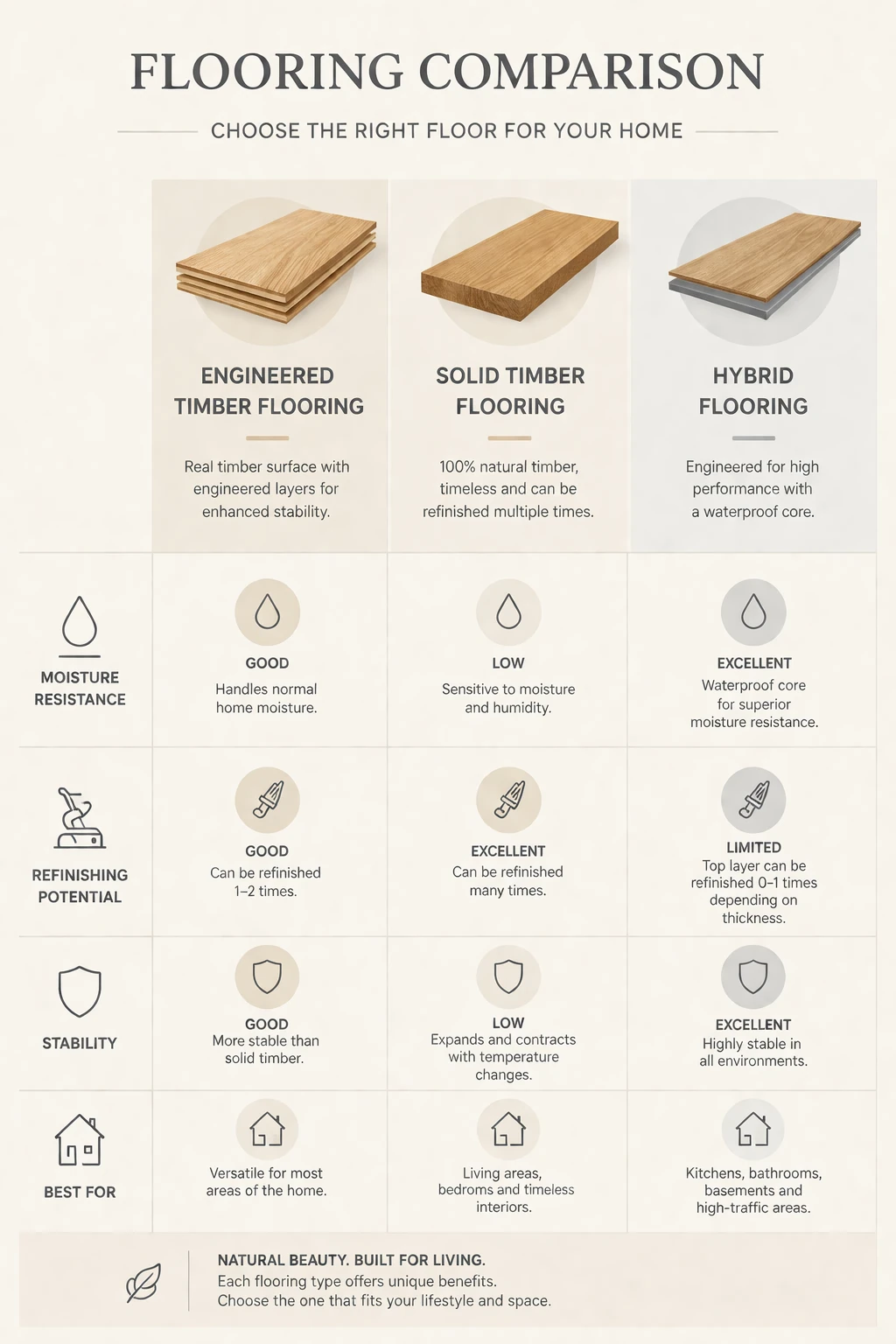
engineered timber suits most modern Australian homes better, while solid timber is chosen for pure authenticity.
Engineered Timber vs. Hybrid Flooring
| FEATURE | ENGINEERED TIMBER | HYBRID FLOORING |
|---|---|---|
| MATERIAL | Real wood surface | Synthetic core |
| WATERPROOF | No | Yes |
| REFINISHING | Yes | No |
| NATURAL FEEL | High | Medium |
| MAINTENANCE | Moderate | Very low |
| BEST FOR | Premium interiors | Wet areas & busy homes |
Is Engineered Timber Flooring Right For You?
Engineered timber flooring is a strong option for homeowners who want the natural look and feel of real timber, but with improved stability and more practical everyday performance. It strikes a comfortable balance between premium aesthetics and modern functionality, which is why it’s become such a common choice in renovations and new builds across Australia.
Unlike some flooring types that force you to choose between beauty and practicality, engineered timber sits in the middle. It gives you that authentic hardwood surface people love, while solving many of the movement and maintenance issues that come with traditional solid timber in Australia’s varied climate.
Where It Works Best?
This flooring performs particularly well in the main living zones of the home, where design impact and comfort really matter. Living rooms, bedrooms, hallways, and dining areas are ideal spaces because they benefit most from the natural warmth and visual richness of timber.
In these areas, engineered timber helps create a cohesive, high-end feel throughout the home. It also pairs well with both modern open-plan layouts and more traditional floor plans, making it highly versatile for different architectural styles found across Australian suburbs.
Suitability for Australian Homes
Engineered timber is also well suited to many common Australian construction styles, especially homes built on concrete slabs, which is very typical in both new builds and apartment living. Its layered structure helps it handle minor subfloor variations and seasonal climate changes more effectively than solid hardwood.
It performs reliably in regions with moderate climate variation, including most coastal and metropolitan areas. From humid summers in Queensland to cooler winters in Victoria, it maintains a more consistent appearance with less seasonal movement.
When It May Not Be the Best Fit?
Despite its advantages, engineered timber is not designed for every situation. It is not fully waterproof, which means it is generally not recommended for bathrooms, laundries, or other areas exposed to frequent moisture or standing water.
In these types of spaces, flooring options with full waterproof protection, such as hybrid flooring, are often a more practical and low-risk choice. Similarly, in homes where extremely low maintenance or maximum water resistance is the top priority, engineered timber may not be the ideal solution.
Overall Fit for Your Lifestyle
Ultimately, engineered timber flooring is best suited to homeowners who value natural timber aesthetics and are willing to provide a moderate level of care in return for long-term beauty and performance. It’s a lifestyle focused flooring option that enhances the feel of a home while still offering more stability and practicality than traditional hardwood.
Why Choose Engineered Timber Flooring?
Engineered timber flooring stands out because it successfully bridges the gap between natural beauty and modern performance. It delivers the authentic character of real wood, while incorporating a structurally engineered core that makes it far more stable and adaptable for everyday Australian living.
One of its biggest advantages is the way it enhances the look and feel of a home without introducing the same level of maintenance and movement issues commonly associated with solid hardwood. You still get the warmth, grain detail, and premium aesthetic of genuine timber, but with a more controlled and predictable performance across different environments and seasons.
In practical terms, this means engineered timber fits naturally into both contemporary and traditional Australian homes. It works just as well in a coastal family home as it does in a city apartment or a large suburban renovation. It brings a sense of natural character into interiors while still supporting the demands of modern lifestyles, including busy households, furniture movement, and seasonal climate variation.
Long-Term Value and Everyday Appeal
When chosen correctly, engineered timber can be a long-term flooring solution that maintains its appeal for decades. The ability to select different timber species, thickness levels, and surface finishes allows homeowners to tailor the flooring to both their design preferences and lifestyle needs.
Over time, it also develops a natural patina that many homeowners find adds even more character to the space, rather than diminishing its appearance. This aging quality is one of the reasons it remains a preferred choice for those who want a floor that feels warm, natural, and lived-in rather than artificial or overly manufactured.
Overall, engineered timber offers a balanced combination of style, stability, and long-term usability, making it a strong contender for anyone looking to invest in a premium timber flooring solution for their Australian home.
Conclusion
Engineered timber flooring continues to be one of the most balanced and sought-after flooring choices for Australian homes. It successfully combines the natural beauty and character of real hardwood with modern engineering that improves stability, performance, and overall practicality.
It offers a refined look that suits a wide range of interior styles, from contemporary apartments to classic family homes. At the same time, its layered construction helps it handle everyday Australian conditions more effectively than traditional solid timber, especially in spaces exposed to changing temperatures and humidity.
With the right selection of timber species, wear layer thickness, and finish along with simple, consistent care engineered timber can deliver decades of reliable use while maintaining its natural appeal. It’s a flooring solution that not only enhances the look of a home but also adds long term value and comfort.
For homeowners who want the warmth and authenticity of real wood without the full maintenance demands of solid timber, engineered flooring remains one of the most practical, stylish, and future-proof choices available today.
Book Your Free In-Home Measure And Quote
Choosing the right flooring becomes much easier when you can actually see how it looks in your own space. A free in-home measure takes the guesswork out of the process by letting you compare different timber tones, finishes, and plank styles under your home’s real lighting conditions not just in a showroom.
It also ensures everything is measured accurately, so you get a clear understanding of materials needed and a more precise overall cost estimate. Beyond pricing, it’s a practical way to get tailored advice on what suits your layout, foot traffic, and lifestyle best. Whether you’re working with an open-plan living area, a renovation project, or a new build, this step helps you make a more confident and informed decision.
Complete the form below to receive your personalised quote straight away.
Get Quote